Sunday, July 10, 2011

Sky


I sit on the porch
and watch the moon rise as the
frogs begin their song

Saturday, July 9, 2011

At Walmart in Monticello

Of all the Walmarts I have been to, this one seems sort of scruffy.  It is not unusual to run into a pile of things that in the process of being unloaded and put away, are abandoned and not put away.  Sometimes the aisles are empty --  new stock is coming but not there yet.

What  a diverse number of things are on my list-- starting with blossom fertilizer and ending with apple fritters -- can be found there, and on sale for a cheap price.  I couldn't believe the price of Schweppes tonic-- $.50 cheaper than what I was used to in my little local grocery.  Butter is shockingly cheap when compared to the price in NYC.

I had been wanting a new chef's apron since my old one got so stained and beat up I threw it away.  Looking on Amazon, chefs aprons sold for $15-20.  At Walmart a chefs apron costs $7.00!

I almost bought some beautiful clay pots in red, green and mustard, just because they were made in Portugal and it is so hard to find anything that is not made in China.  But I did not need clay pots.

Walking down the aisle that sold tuna fish, we came upon a giant can, it must have had enough tuna to feed 50 people.  R wanted to buy it just for the sight of it, so that he could look at the foot high giant can of tuna.

photo courtesy of Walmart

At one point as I was pushing my big cart down the aisle to meet R, I noticed a woman coming furiously at me.  She looked slightly tense, determined to get someplace, and not let anyone get in her way.  It was a mirror and I was aiming at my image.

Wednesday, July 6, 2011

Thornden Park Rose Garden

R and C and I visited the Rose Garden at Thornden Park.
When we first came in, R was interested in the most fragrant blooms.  We asked a volunteer who was pruning and she said sadly that she had lost her sense of smell 20 years ago, but there were always dead heads to take off.  She continued her pruning.  On this melancholy note, we explored what was left in early July of what comes into full glory in mid June, and were not disappointed.


Tuesday, July 5, 2011

First Fridays: Poetry Reading at Narrowsburg Public Library

Taylor Mali
Marie Elizabeth Mali

Taylor Mali and Marie Elizabeth Mali performed at the Narrowsburg Public Library July 1.  It was a packed house.

They presented a well prepared set of poems beginning with a bilingual recitation (she recited the Spanish, he the English translation) of a love poem by Neruda which set the tone for what was to come.  Two people not only perform together, they live together, and love each other.  I have never seen anything like it before.  It was almost too good to be true:  two attractive, accomplished, funny and charming people who both write well and perform well together.

Taylor Mali is the more practiced performer, with his big voice and persona. He could command a stage as big as Yankee Stadium, so the small reading room in the Narrowsburg library was very cozy and intimate a stage for a poet whose poem about how to write a political poem begins "However it begins, it's gotta be loud."  His poems about teaching have inspired over 700 people to become teachers, and when he hears from 1,000 (hopefully by the end of August of this year), he will cut his hair and donate it to Pantene Beautiful Lengths, a hair donation organization for women with cancer.  Even though he is best known for the poem, "What Teachers Make," he did not read it,  closing instead with "The The Impotence of Proofreading."  Marie Elizabeth Mali is no less accomplished a writer, but her subjects are more diverse and influenced by her background of Argentinian-Swedish family.

First there was the usual First Fridays open mike reading, with ten readers, closing with Vera Williams who recited her poem about how to make a peach sandwich.  Master of ceremonies was as always the charming Corinna, a teen, whose mother manages the programing at First Fridays.   Corinna recited one of her own poems, and then cheerleaded the rest of the readers.
Vera Williams


Friday, July 1, 2011

Mushrooms

INdian pipes
Went looking for mushrooms today, though find identifying them challenging. Indian pipes are not mushrooms, they just seem to belong in that family since they do not have chlorophyll, turn dark, and live off the decayed leaves in the forest.

The second mushroom has little specks on it as if it were decorated pastry.  This one is living in the moss, but is covered with pine needles and rooted in a decayed leaf.

The third one looks like a very nicely made poached egg, and learned it is called an American Caesar. 

Wednesday, June 29, 2011

Bad Teacher

 Cameron Diaz is very funny and sexy in this movie.  She plays a gold digger who slips under the radar of her principal even as she arrives at work each day in mini skirts only to show movies to her students.  The students seem thoroughly engaged by these movies, which nearly always have an educational theme.  Her rival, a truly dedicated, also funny character named Amy Squirrel, is the exact opposite.  She plans her lessons, tries to have fun with the students, and reports Halsey's (Diaz's character) bad behavior to the principal.


Diaz struts her stuff in amazing shoes and skintight dresses.  I read an article about her that said if she had lived in another era with better directors Diaz would have had a brilliant career.   The material in the movie is thin, but I am grateful for a movie that allows a gifted comic actress to make us laugh.

Tuesday, June 28, 2011

Indigo bunting, scarlet tanager, robins

Indigo Bunting, painting by Louis Agassiz Fuertes

Even though there are lovelier birds than robins here, it can be dramatic to watch robins hunt and feed.    They are so very thorough.

A robin captured a fresh worm in her bill.  She hauled the wriggler across the hot pavement.  Two bitty steps pulling her cargo, then a rest.  Two more bitty steps.  Progress was slow but steady as she made her way from one side of the road to the other.  Halfway there, the worm broke in two.  This did not stop her from clipping the fragment in her bill and pulling it a quarter inch at a time until she got the worm to the other side then gently with the most delicate of manners she ate him tidbit by tidbit.  But before she tackled the eating of the worm she'd successfully carried to the grass, she returned to the hot pavement where the rest of the worm had begun to show signs of life.

Scarlet Tanager, photo by Terry Sohl


Again just as she did with the first half, the robin pulled the writher by her a bill a quarter inch at a time until he joined up with the other portion.


photo by Ryan Bushby
Did the two halves greet each other at their reunion?   Were they glad to see each other?  I know nothing of worm communication.  Now it was time for the feast.  She ate a dainty snatch at a time, did not gulp or grind.  She chewed slowly and swallowed silently as the best brought up of us do.  When the worm was a manageable size, she flew off with it in her bill to her nest to share with the rest of her family.


Tuesday, June 21, 2011

Sullivan County

We arrived at Ten Mile River yesterday morning when it was still spring.
After unpacking the car,  R noticed a scarlet tanager in a pine tree.


A red spotted purple butterfly basked in the bright noonday sun among the impatiens waiting to be planted.  At first, from underneath, with the orange
and white and black markings, I thought it was an admiral.  No, its first
cousin.  The butterfly looked brand new, no bird had taken a bite out of
him yet.  His wings shimmered as if still wet from birth.
 
Took a walk up the steep hill just to stretch my legs.  Ran into a large cluster of
mountain laurel, some pink, some white. 
laurel
rhododendron
Can't believe I ever confused rhododendron with laurel.
Must be the similarity of the leaves.  Laurel looks more
like ballooning petticoats in the shape of a ten
pointed star.  Each part of the flower petal has
a tiny vertical line almost like a border between
one part and the next.

Lest all of this sound like Eden, in order to get here, we drove
up the Palisades, then onto 6 and 17 west, and passed
at least five deer who had been struck and killed by speeding cars. 


Saturday, June 11, 2011

The Trip

The Trip, directed by Michael Winterbottom, and starring Steve Coogan and Rob Brydon as themselves, has a foolproof structure.  The structure is  based on a BBC tv series in which the two characters take a restaurant tour of northern England.  Each episode features a new location.  Originally suggested by Steve's girlfriend, who has since backed off such a romantic journey, the trip takes the two men into and out of luxurious accommodations,  gorgeous scenery, and tantalizing versions of sauteed scallops.

We learn how close the men are by how well they accommodate each other through bouts of talkativeness, recitations of Wordsworth, singing, and imitations of actors, mostly British, which are hilarious.

It's a road movie, a buddy movie, a food movie, and  a story about family and loneliness.  I am so grateful not to have to see a Judd  Apatow movie in order to have a belly laugh!

Monday, May 30, 2011

Bad week for the neighborhood

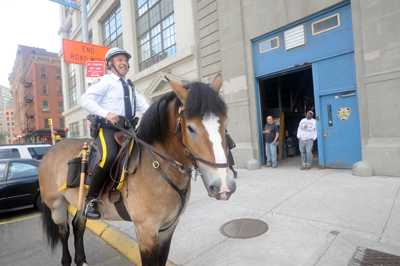
It started with a hand drawn illustration of a horse posted in my building's elevator with a poignant message from its creator, who I would guess is eight years old.  My young neighbor wrote to inform us that even though  she had hoped that  the police department might be looking for an alternate site for the World Trade Center security command center, that hope was ill founded.  The police don't have an alternative site for the command center, and here it is, three months from the 10-year anniversary of the terrorist attacks that took down not just the trade center, but the command center itself at 7 WTC.

So our beloved horses, and gentle mounted police, numbering in the single to double digits, with the open doors allowing us to see in to the stables where the dark chestnut animals eat and sleep, will be replaced with a command center manned with hundreds of police on the alert for terrorist attacks. 


Photo by Carol Glassman / Tribeca Trib

The other messsage our neighbor wrote was that the fire department -- ladder 8-- aka the Ghostbusters firehouse-- was on a list of fire houses that were considered low use, thus dispensable in this round of budget cuts.


Photo by Carl Glassman/ Tribeca Trib


Given the concerned neighbor's age, it is clear that both of these community cornerstones are favorites of children under 10 who are always welcome, and often invited in to either feed the horses (when my daughter was small, we used to bring carrots to the stables) or to have a seat in the firetruck if time allowed and some life saving event wasn't going on.

When I was recently hit by a car a few blocks from these places, it took only minutes for the fire department to respond, and I am very grateful for their gentle care throughout my transfer to the emergency room at the Downtown Hospital.

This reminds me of another loss to the neighborhood, even though it is farther uptown:  St. Vincent's Hospital.  Their critical care unit was excellent (almost said "is" because I can't adjust to life without that hospital to call on).

The crowning blow came in the New York Post headline:  Chez Perv.
Dominique  Strauss-Kahn, the IMF chief accused of rape by a hotel maid, and arrested on the runway as he was making his escape, has moved into a Franklin St. address.  We may not have room for police on horseback, or firemen, but bring us your rich unsavory people under house arrest

 We need to hold on to the feeling of community these important institutions bring to us.

Sunday, May 29, 2011

Bridesmaids

When a woman gets married, it can force a wedge between her and her friends.  She must sacrifice relationships that are not based on sacred rituals.  She has now pledged her troth to her husband and children, and his parents claim higher priority than her best friend  or even her sister.  It changes the whole social matrix of a woman's life.

Bridesmaids acknowledges this painful and poignant change.  Mostly it is just a very funny series of sketches about the perfect wedding run amok, which has become a genre of comedy since the wedding business has loomed large enough to become a huge industry.  (One of my favorite lines comes from the bride's father who says "I am not paying for this.")

Kristen Wiig plays Annie, the maid of honor to her best friend, Lily, (Maya Rudolph), who is now moving in higher class circles than Annie is used to.  A new best friend has emerged from this pricier circle, Helen (Rose Byrne) who is prettier, richer, and more ready to spend the manic energy needed for a perfect wedding.

The cast is very talented, and the love interest of Kristen Wiig, Chris O'Dowl, is so perfect she can't see it at first.  There are some funny scenes having to do with police cruisers and missing persons. 
It is a relief to find a comedy that is full of talented women and written by women.  The few times the comedy doesn't work that well I suspect were inserted by guys and sort of just gross you out.


Sunday, May 22, 2011

MIdnight in Paris

Woody Allen's new movie gives the audience not only very attractive actors doing their work perfectly but also some philosophy to think about.  How many of us have wished we lived in a different time, or thought that we were born too late?  (We rarely think we were born too early.)  Owen Wilson plays a successful screenwriter whose visit to Paris with his fiance brings on a bit of magic, allowing him to visit his favorite artistic era just as he is in the throes of writing his first novel.  While we are chewing over the meditative bits about needing to accept the time you live in, there is some fine music being played by Sidney Bechet, beautiful costumes worn by the lovely Marion Cotillard, and  shots of the city's landmarks and rooftops.

Adrien Brody does a wonderful comic turn as Salvador Dali, Kathy Bates plays a humane Gertrude Stein.  All of the casting and makeup are marvelous.  It reminded me a little of my other favorite Allen movies, like Zelig, and Purple Rose of Cairo where the leap off the screen, the leap of imagination is gracefully done from scene to scene, and the audience has no trouble accepting this alternate reality.


The absurdity of life pops up and makes you laugh at regular intervals, but a movie that is both  intellectually accessible and challenging  is extremely rare.


Saturday, April 23, 2011

Hazel Dickens


Hazel Dickens died yesterday.  Her obituary was in the New York Times today.  I always notice the women who rate an obit because there are not as many as for men.  Dickens sang about the hard lives of the coal miners.  Her voice was more mournful than Loretta Lynn, her songs had a harder edge than Dolly Parton.  She sang in the movies Harlan County and Matewan.  You can hear her sing here: Fire in the Hole.  Her voice goes right through me.

Sunday, April 17, 2011

Source Code

Science fiction about time travel trips me up.  It depends on the belief that someone can be in two places at the same time.  Source Code would have us believe that the main character played by Jake Gyllenhaal is not traveling through time, he is just living in an alternate reality in order to discover  the criminal intending to wreak havoc on a major metropolis.  He can go back to the last eight minutes of an explosion when everyone on a train is about to be killed, an infinite number of times.  Each time our hero learns a little more about a crime about to take place, and Gyllenhaal's delivery of the lines he must repeat over and over again is one of the pleasures of this film.  He is the not the only one whose acting buoys up a rather baffling premise.  There is lovely Vera Fermiga as a sympathetic military official, and Jeffrey Wright chewing the scenery as an evil scientist, and Michelle Monaghan looking winsome as the love interest.

Even though it left me scratching my head, I enjoyed the movie's well edited suspense.


Monday, April 4, 2011

my mother's eye is scratched

This morning my eye feels itchy, as if there is a very fine hair that if I could just remove, all would be perfect. The little orb would go back to lying in its perfect solution of fluid.  But this is an illusion.  No matter how much I scratch at or poke at or try to tug the sleepers from the corner of my eye, it still feels as if something infinitesimally small is trying to work itself free and not succeeding.

Earlier this week my mother suffered a scratch on her eye.  She  is being treated for macular degeneration with laser therapy to reduce the errant blood vessels that are blocking her macula, that centerpiece of the eye that keeps things in focus.  When she went home, she was in pain, and the pain increased, and her eye was swollen.   She phoned the doctor who had her come back to his office, and learned that her eye had been scratched.  "This sometimes happens" was the doctor's explanation.  (Wouldn't you like to throttle him?)

Am I feeling sympathy pains, or worrying that I will soon suffer the same eye disorder as my mother since it is genetic.  Or maybe is it  just a case of itchy eyes.


Friday, April 1, 2011

Le Quattro Volte

You don't need to know how to speak Italian to watch this Italian movie, and it has no subtitles.  The movie is not purely visual though the photography is quite wonderful.  It has an important soundtrack which consists of the sounds of men tamping down charcoal beds with shovels, goats bleating before being milked, a woman sweeping the floor in a church, a sheep dog barking, the final block being put into place in a mausoleum to enclose a casket.  The action moves from a forest where a goatherd tends to his flock, then to the man's house where he tends to a nasty cough with a potion poured out in a folded up magazine page.

The potion is very important to the man whose cough does not improve.   A town performs a passion play complete with a christ figure carrying the cross up a hill to join two other crosses already in place.

The camera is never too close to people, with the exception of the goatherd.  Most of the shots are long shots.  The goats are shot close up and we get to know them pretty well.  The mountains, the trees, the dog, and especially one very tall pine tree, these are our familiars by the end of the picture.  The picture begins and ends with smoke.  We learn how charcoal is made in an ancient practice with an architectural form worthy of Stonehenge.

I remember in the preview the title was explained-- something about how man lives "four times" -- as mineral, vegetable, animal, and thinking being.  We watch the coal, the pine tree, the baby goat, and the old shepherd progress from beginning to inevitable end, as smoke. 


Thursday, March 31, 2011

Heard a Mockingbird today

Heard a mockingbird today singing its heart out in the middle of a bush as we walked east on 23rd St in the middle of the day.  At first we thought it was an alarm, the sound was so exaggerated and loud.  Then I located the animal, his head thrown back like Edith Piaf, going through its extensive repertory of imitations, including a catbird, a starling, a robin, a catcall, an engine warming up, a towhee, a whistler, and on and on it went.  Another man paused to listen. He didn't need to look, just to listen as the concert continued for five minutes.  No amplifier needed, this thing was singing for the upper deck.   The bird's white-streaked tail was tipped way up to the moon as it gave its heady aria to all passersby for free.  It was full of joy.


Morgan Library: Diaries

R and I went to the Morgan to see the Diaries exhibit.  Thought of the difference between diary and journal.  Both keep records, but diary implies daily, more everyday events, keeping track of what you did, who you saw, what happened.  Journals keep for writers records of what they mean to do, experiments, drafts of things, even. 

Examining three centuries of diaries made us want to begin keeping a diary right away. You could tell how successful the exhibit was by the expressions on the faces of the visitors.  Many were smiling that blissed out smile of surprise that comes with unexpected pleasure.

Some highlights:

--an oversize notebook of John Steinbeck kept while writing the Grapes of Wrath. 
His goal was to write two pages a day, so simple. 

--diaries of Thoreau whose beautiful penmanship wrote each carefully chosen word


-- E/B White's typescript of writing about his childhood every day which  led to the opening of Trumpet of the Swan.

--Walt Whitman's tender record of the wounded soldiers in the Civil War

--Samuel Pepys' writing in shorthand about the London Fire

--Charlotte Bronte's griping about her job as a teacher in a boarding house

--American record of the Boston tea party

--Hawthorne family diaries

Whether writing down history, or recording what your family had for dinner, diaries bring to life what has passed. 


Barney's Version


Barney’s Version
Paul Giamatti is having a great career.  He has played John Adams, Harvey Pekar,  and Joe Gould as well as the  misanthropic wine taster in Sideways.  In Barney's Version,  he plays a man whose life we see develop from youth to the onset of senility.  Sometimes because of certain plot elements, we wonder if the version Barney gives has something to do with a crime, but it turns out that we see things through his eyes as he falls in love and stays in love with the lovely woman he finds at his second wedding.

He really loves this woman, and she is worthy of his love, but is he worthy of hers? We are not quite sure with all the scotch drinking and cigar smoking if that is enough to understand his character.   It isn’t Giamatti's fault.  The men who create Barney's foursome of friends have more life together than the man and the woman at the heart of the story. The direction lingers too much on the scotch drinking and seems repetitive or draggy in ways that keep the characters from truly developing.  Giamatti is a fine actor.  Dustin Hoffman plays his father beautifully.  (Hoffman’s son plays his grandson and is also quite good).  Barney’s second wife, played by Minnie Driver, is delightful as a vulgarian with her master’s degree being waved in his face every other minute.  

There are fine details and charming scenes mostly between the men which create a feeling of poignancy, of a life really being lived.   For this I am grateful.  A movie about a realistic person who chased a woman for years until he could marry her and never fell out of love with her, that is a sweet dream many of us could wish for.  So I forgive the movie its flaws for its romanticism.  

Saturday, March 26, 2011

My Favorite Website: NYPL


Where else can you find important answers to reference questions and an image of the day and put all sorts of poetry books on hold for later pick up but the New York Public Library?
The image at left is of the McCoy Sisters, I know not more than that, but I find their movement and expression delightful since I take such delight in my sisters.

New York Public Library

Thursday, March 24, 2011

Cedar Rapids

We watched the movie, Cedar Rapids, at a 1 o'clock show in a theater where we were the only two there.  I guess the movie is at the end of its run.  How delicious to see a movie on a Thursday afternoon when everyone else is at work.  Another man sat in the back, who turned out to be one of the staff.  When the lights went down, he announced that the show would now begin, and we should enjoy ourselves, and then he left.  This is not usually how movies start at big chain theatres.

The main character, named Tim Lippe (Ed Helms), is a rube, simple,  naive,  a boy in man's clothing.  He has never left his home town of Brown Falls, Wisconsin, so when he is called on by the head of his insurance office to attend a convention in Cedar Rapids, which is a big town for this guy, he is so green he deosn't know that everyone, even him, has to go through security check, even when the security check guy is someone he knows very well.  

Once in Cedar Rapids, the blowhard, played by John C. Reilly, the hip woman, played by Anne Heche, and the stolid roomate, played by Isaiah Whitlock, give our hero  a little seasoning.   Alia Shawcat, who played Maebe on Arrested Development, does a fine turn as a hooker.  All the women, including Sigourney Weaver who bravely allows the camera to show her age, hold their own in this male id-centered comedy.  The comedy comes and goes, but at heart, the film is  a coming of age story for the sweet insurance salesman. It gives honest businessmen everywhere a reason to cheer. 

Sunday, March 20, 2011

Bill Cunningham New York (movie)

Bill Cunningham loves what he does.  Riding his bicycle through Manhattan streets, he locates fashion as it is evolving in the moment, then he photographs it, and compiles witty montages of what he has discovered every week in his "On the Street" column for the New York Times.  I had barely noticed that he also contributes the photographs for the society column which is made up of the philanthropists who donate to charities, and have special events to celebrate and garner more cash for their causes.  Three reasons to see this movie:  joie de vivre, fashion, how to ride a bicycle in NYC. 


Sunday, November 28, 2010

Inside Job

This muckraking movie makes me mad with its shocking analysis.  

People are interviewed  from  Iceland, where banks once regulated and stable were deregulated and drowned in debt, nearly bringing down the government, and laying off thousands of people.  In a country of 300,000 that has a huge impact.  In the United States where deregulation began with the Reagan administration, the continued ripple effect on the global economy resulted in larger layoffs, more recessions, and continues to this day under Obama and what one interview subject called the "Wall Street government."

Money is made on debt that cannot be paid.  The higher the debt, the more leveraged the bank becomes, until eventually, so large (too large to fail), the executive who was supposed to be overseeing this, bails out and gets his package, which includes millions of dollars.  Sometimes these executives, knowing that the company is headed south, sell their shares and take them home with their severance package, and here's the funny thing, their heads held high.

When what you are selling is so complicated that it cannot be explained without a programmable calculator something is wrong.  And it is sinking the financial markets around the world.  Unbridled capitalism bankrupts us all, punishes the poor, and makes the rich make out like bandits.  This movie urges us to take the system back from the criminals.  And to change the way government works.  This movie, though most of its heavy firepower is aimed at the GOP, does not exempt Clinton, sitting very cosily with the biggest of the marauders, or Obama, who has allowed the status quo to continue.

There are some heroes in this film, who speak before and after those caught red handed.  Unlike the Federal Reserve Governor, and the Harvard University economist, and the bankers forced to testify to Congress,  there are  heroes like a consumer advocate who warned Greenspan, and then Bernanke about what was happening to no avail.  There is an executive at the International Monetary Fund whose paper was published criticizing the mathematical model that used derivatives to make money on bad mortgages; he was subsequently shunned.  George Soros says some things about the inequity of executive compensation that sound dead on. 

Eliot Spitzer sits in a large vacant room with miles of windows making us wish he had never gotten in trouble with someone not unlike the madam who was interviewed earlier about what Wall STreet traders like to do after their fifteen hour days on the floor.  Spitzer reminds us how he used to go after the people who were raiding consumers' accounts to line their own pockets.  He says he isn't in a moral position to say much about their morals now. Damn.


Tuesday, November 9, 2010

Howl


Howl with James Franco


The movie begins with a recitation of the poem as it might have been delivered in a dark subterranean coffee shop in San Francisco in 1955, shortly after it was written.  James Franco wears the thick black horn rimmed glasses, the white t shirt under the buttoned down white shirt, just the way that Ginsberg wore these things.  Franco’s voice takes on that raspy incantatory drone  that was Ginsberg’s performance persona.  The voice, and the juicy words that run on and on return us to 1955 – but do these lines speak to us now as they did in 1955?  Perhaps we do not need them now as we did then.
James Franco

The opening titles show glimpses of the animation to come.  Armies of men carry identical brief cases, wear identical hats, march across an unknown grey city.  Photographs of Ginsberg and Orlovsky, his lifelong partner, actual photographs, look a bit scruffier than the cleaned up actors who play their counterparts.  The cold war is represented by missiles pointing ominously toward us the viewers.   In this context, the beat poets were railing against conformity, against war, against restrictions of all kinds.

Franco plays Ginsberg especially well when he is full of longing.  He speaks to an unseen interviewer (the script comes almost entirely from transcripts, interviews, and the poetry itself) about his journey from a young poet wannabe in the shadow of his straight traditional poet father.  His sexuality he hid from his parents.  He was put in an insane asylum when he was 21 ostensibly because of his homosexuality, and was released when he agreed to become straight.  After two years of working in advertising and rejecting his true nature, his therapist encouraged him to do what he wanted, and the rest is history.

Allen Ginsberg
The animations in the movie are distracting.  The images of star bursts that denote orgasms, the explicit sexual couplings, detract from the power of the words.  But this is a movie. I can see why the filmmakers thought so much time with just the words-- staring at the screen, listening to Franco recite, might be boring without some action.  

 How gratifying to hear a poet's words treated with the seriousness of a love affair, or a war, or a heist, or some other common subjects of movies.  I remember when the movie came out about Sylvia Plath.  They had everything in that movie except the poetry.  This movie has the poetry front and center and I am grateful.

Thursday, November 4, 2010

Poets Forum on Contemporary Poetry:Wild and Strange Language


Lyn Hejinian
Carl Phillips
Ron Padgett

Kay Ryan


The four poets sat in a row in front of microphones, Lyn Hejinian the language poet,  on the far left.  She began by saying in her high girlish voice, "Here we are in a row, I must be "A".  Kay Ryan piped up quite promptly "And I must be "Z".  Chortles all around.  We knew where the two poets stood on the meaning, or lack of meaning, in poetry, especially when it comes to language.

Hejinian read examples of what she thought of as showing wild and strange language.  (No poet would like to be accused of using tame and ordinary language, she said.)

First came Robert Grenier, from his book "Sentences", available online.

She may or may not have read this:

PAW

he barks at things gone by
two trees

stepping through the water to the rocks

five sound shut doors

LOOKING AT FIRE

ashes to ashes

looking at the fire

at has been added

Hejinian champions  the use of language in an aesthetic sense.

Padgett ruminated on his childhood a bit, thought of how language is enjoyed sometimes without meaning necessarily.  Children like to  repeat sounds over and over again until they are drained of meaning and remembered as something else, something coming in to the ear.  He also enjoyed discovering the concrete poets, the wild poets whose works contain pure sounds and playful shapes on the page.  Later, he pointed out that William Carlos Williams' poems in Spring and All were electrifying.  The red wheelbarrow poem said it so plainly.  Padgett is charming and funny, and full of plain spoken truths, with a childlike simplicity that is seductive.

 Phillips  handed out a leaflet with two poems : on one side from Laura Jensen, "Heavy Snowfall in a Year Gone Past," which ends with the moon looking  down and judging,

not the maze of anger
but the fury
at the wasted years,
at the waste of the tender snow
Wasted, wasted, the birds crackle,
wasted on you.

There was also a deeply erotic beautifully structured poem by John Wieners, "Anniversary".
The diction changes mid line

Cigarette between his lips, would they were mine
by this present moon swear allegiance
if he ever look, see clouds and beaches
in the sky, by stars lend his eyes shine.

Kay Ryan had brought this poem by Robert Frost.  She asked if we received the handout.  When there was an awkward silence, she replied, "I didn't bring one."

A Dust of Snow

The way a crow
Shook down on me
The dust of snow
From a hemlock tree

Has given my heart
A change of mood
And saved some part
Of a day I had rued.

What excited Ryan was how poetry could change a person.  The person in the snow was not in a good place, and as a result of the snow falling on him, had entered a new mood.  Such simplicity, and tight little form has the power to create a feeling.

Hejinian challenged that poetry did not have to do that, that was too restrictive.

"Restrictive!" cried Ryan.

And so Poet A and Poet Z laid out their positions.  It was an argument we could have used more of.  But it was enough for me to understand the difference between Hejinian's point of view about poetry, that it should have as much breadth and range and abstraction and freedom as jazz or a Jackson Pollock painting, and Kay Ryan who wants her poems to have words with meaning.   With no meaning, you have no power, she claims, and I agree. 

Sunday, October 3, 2010

Late September

The tips of the leaves
so recently green have grown
an edging of brown

Thursday, September 30, 2010

Weather

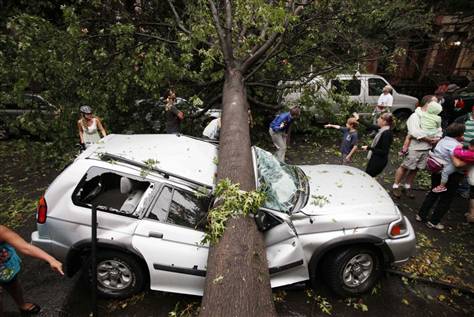
Scary weather lately.  A tree fell on a car and killed a woman waiting patiently inside for the winds and water to pass.  Trees are now becoming something to be leery of.  Some of them have fallen on pedestrians in Central Park.    Trees used to be the thing we rested under, sought for shade, looked at in wonder when their leaves changed color.  Did New York  used to have tornadoes?


Monday, September 6, 2010

Matisse: Radical Invention, 1913–1917

Henri Matisse painting Bathers by a River, May 13, 1913. Photograph by Alvin Langdon Coburn. Courtesy of George Eastman House, International Museum of Photography and Film, Rochester                   


The first gallery of paintings showed how Matisse was taught to paint copies of the masters, but learned to develop his own interpretation of the classic compositions,  beginning with a series of paintings on the subject of Arcadia.  What a great subject for a series of poems. 

I was captivated by this drypoint of Greta Prozor. 

Drypoint, Greta Prozor, MOMA