Beetle Queen Conquers Tokyo Trailer from Myriapod Productions on Vimeo.
Thursday, June 3, 2010
Beetle Queen Conquers Tokyo
Beauty and transience are linked in Japan. Think of cherry blossoms, and how they are celebrated in ritual gatherings, adored for their short lives as much as for their visual splendor. In Beetle Queen Conquers Tokyo, a first film by Jessica Orent, the Japanese people show their love of insects through collecting. In the US if you go into a pet store, you see the cuddly puppies and cute kittens. In Japan, children yearn for the stag horn beetle in the square plastic box. Women go to pet supply stores in search of the best bedding for their insects, and the best insect snacks. At night, the hunters of the beetles are out with flashlights and special nets to capture the beetles who climb trees. Anyone in the beetle business seems to know just how to kick the base of the tree to dislodge the unsuspecting bugs.
Overhead images of people swarming at intersection in the rain, their heads under colorful umbrellas, link our species to the insects. Constant voiceover relates how poetry, art, nature, and philosophy relate to the Japanese love of insects. Most of it is in Japanese, requiring the viewer to read the subtitles which takes our eyes off the images. This is a minor flaw, but it leaves the audience somewhat exhausted after watching.


Saturday, May 15, 2010
Please Give
Nicole Holofcener makes movies about people I recognize. It is a relief to sit in the theater and not have to watch young men shooting each other, or middle aged men pairing off with very young women, or young men in buddy movies where the arc of the story begins with pure foolishness and ends with a little less foolishness. I know that I will see the Iron Man movie (I love Robert Downey Jr) and will be tempted by Robin Hood (Russell Crowe is no slouch) but still, superheroes and medieval legends are not the concern of my everyday life.
So when middle aged women with inner lives are portrayed on the screen I snap it up. Why should Meryl Streep have a lock on this?
This is Holofcener's specialty, and Please Give is her latest and most wonderful. I read that Catherine Keener is her muse.
Long live Catherine Keener.

The movie begins with a series of mammograms shown while the Roches sing "No Shoes" in the background. It was inevitable that mammograms would feature in a film at some point. Accompanying the images with such a finger snapping tune leavens the tone and introduces a breast technician as a leading character. The movie shows how we feel about cast off furniture and clothes of the dead, and our ambivalence at living in the richest city in the world while surrounded by the homeless.
Any mother who has ever lived with a daughter whose whole feeling of self worth centers on having the right pair of jeans will also recognize herself in this movie.
So when middle aged women with inner lives are portrayed on the screen I snap it up. Why should Meryl Streep have a lock on this?
This is Holofcener's specialty, and Please Give is her latest and most wonderful. I read that Catherine Keener is her muse.
Long live Catherine Keener.

The movie begins with a series of mammograms shown while the Roches sing "No Shoes" in the background. It was inevitable that mammograms would feature in a film at some point. Accompanying the images with such a finger snapping tune leavens the tone and introduces a breast technician as a leading character. The movie shows how we feel about cast off furniture and clothes of the dead, and our ambivalence at living in the richest city in the world while surrounded by the homeless.
Any mother who has ever lived with a daughter whose whole feeling of self worth centers on having the right pair of jeans will also recognize herself in this movie.
Sunday, May 9, 2010
Good Morning
Good Morning
In the sink the cat’s dish gets a swish.
The dregs need rinsing
from yesterday’s coffee.
The kettle needs filling.
The pilot light clicks then whooshes
into flame, and turns the copper bottom red.
In the tub, three minutes for the sponge bath
end
just in time for the kettle’s whistle.
Damp feet step gingerly beneath a bath towel.
The filter sits in the cone,
the cone on top of the carafe,
the coffee, one half cup, in the cone.
Steamy the water that falls on the coffee,
then the scent of beans
The cat begins to eat
The day can now begin
Tuesday, May 4, 2010
Marina Abramovic at MOMA

She creates works designed to make you uncomfortable. It is legitimate art, but when she throws her naked self at a pillar over and over again, and then walks back to repeat this gesture of futility, all I can think of is the physical damage she is doing to her body, which is her medium. I know it is her right to do that to herself, but I can't help but feel sorry for the chronic masochism involved.
I liked best the work on video and in photographs that showed her performances with her partner, Ulla. Below is their piece, "Rest Energy."
There was tension between the two of them that took a little bit of the heat off the audience.

As it is, many people are participating in "The Artist is Present" by sitting across from her in a chair, and being photographed under magnificent lighting.

Artsy's page on Marina Abramovic
No Sherman Alexie, alas
PEN International Voices Festival for some reason replaced Sherman Alexie with Christopher Hitchens, an intellectual and excellent polemicist who thought that Henry Kissinger should have been tried for war crimes, and made an excellent case for it in his book. But Christopher Hitchens is no Sherman Alexie.


Here is a clip of Alexie on the Colbert Report explaining why he won't put his books on the Kindle.


Here is a clip of Alexie on the Colbert Report explaining why he won't put his books on the Kindle.
Sunday, May 2, 2010
Times Square May 1, 2010
On the way to the theatre last night, I ran into a police barricade. No matter what block we turned to, from Seventh Avenue to Eighth Ave, from 45th St to 46 St., police insisted that we stand back, get out of the way. I had a flashback to the Republican National Convention when we tried to march peacably along a preordained route and police kept yelling at us to go a different way as if we were the source of the trouble and not the war in Iraq and other misconceived political decisions that brought us out to have our say.
Last night was a simple matter of walking to the theater and being redirected to the curb. When I asked a police officer what was the matter, she only said, "A smoking car." Then she said very indignantly, "get out of the way. You aren't doing any good standing there."
Another person said, "Its the Islamists."
Times Square requires advanced pedestrianship in the best of circumstances, that is when thousands of tourists, vendors, residents, crooks, and others are walking in a zigzag pattern. You have to bob and weave just to get through the street. But when people are in the way because of a police barricade, and then you try to get to the front of the line and ask a police officer what is going on, you have to be pretty aggressive with your zigging and zagging.
I had bought tickets to see a play. The play was going to start momentarily. The police prevented us from attending. After a while the police said that all performances were canceled. This was after they said to call the theaters. There was no way to get through to the theaters by phone or foot or email or anything. Now I have two tickets for last night's performance. When I wrote to NY1, they forwarded this announcement from the Broadway League:
"There
were no evacuations from Broadway theaters last night. Due to police activity
that closed a few streets in Times Square, there were some late curtains but
all shows did go on. For exchanges or refunds, theatregoers should contact
their point of purchase. All Broadway matinee and evening shows will
go on as scheduled today.
The
proper authorities are doing their jobs to keep Times Square safe for everyone,
and Broadway shows are setting their stages to delight audiences."
-
Charlotte St. Martin, Executive Director, The Broadway League
The smoking car was treated as a serious terrorist threat. It contained two containers of gasoline, some propane, a couple of alarm clocks, and some fireworks.
I know that there are people trying to do us harm, and that it is the job of the police to keep us safe, but I hate it when the police lie to me.
Bomb Scare Times Square May 1
Friday, April 30, 2010
Heather McHugh

NEW SALON: READINGS AND CONVERSATIONS
Heather McHugh, with Robert N. Casper
A reading and conversation in an intimate format.Robert Casper introduced the poet as a former teacher of his, and it was clear how much respect and awe and admiration he had for her. However, when he asked her to start the evening with a reading, she was expecting conversation, and her post-it note laden notes on topics showed that she was prepared for an interview more than for a poetry reading.
McHugh was good-natured and even joyous throughout her remarks, which were many and beautifully spoken in perfect English about what has meaning to her in her writing. " I write in order to find what I mean," she said at one point. She read the poem that was provided for those of us who did not come with books in hand, "Fastener,"
Fastener
One as is as another as.
One with is with another with;
one against's against all others and one of
of all the ofs on earth feels chosen. So the man
can't help his fastening on many
(since the likes of him like
look-alikes)...When the star-shower crosses
the carnival sky, then the blues of the crowd
try to glisten, to match it; and the two
who work late in the butcher-house touch,
reaching just the same moment
for glue and for hatchet.
When I heard her read it it made sense. Reading it on the page I struggle with the meaning and the sounds crashing into each other. Those first four lines trip me up with their use of conjunctions and prepositions as nouns. But McHugh's playfulness and lightness of touch made it all clear. She was almost apologetic about how she got expressive after the first four lines, as if it were the weakness in her writing, when in fact it is the part that I like best.
She was very at ease riffing on ideas, pulling snatches of poems by Emily Dickinson out of her fecund brain by heart, and she quoted Borges, and Wittgenstein ("Our lives are endless precisely in the ways our visual lives are endless.")
Here is what I remember:
--We live in our senses. All five senses have verbs that can be used either in the transitive or intransitive case.
--It is important to entertain both sides of every question, consider opposites, to not just go for the knee jerk response or emotional simplicity of things. Dare to be complex.
--The root of skepticism is in looking.
There is a beautiful more accessible poem on the poets.org website,
What He Thought.
For Fabbio Doplicher
We were supposed to do a job in Italy
and, full of our feeling for
ourselves (our sense of being
Poets from America) we went
from Rome to Fano, met
the Mayor, mulled a couple
matters over. The Italian literati seemed
bewildered by the language of America: they asked us
what does "flat drink" mean? and the mysterious
"cheap date" (no explanation lessened
this one's mystery). Among Italian writers we

could recognize our counterparts: the academic,
the apologist, the arrogant, the amorous,
the brazen and the glib. And there was one
administrator (The Conservative), in suit
of regulation gray, who like a good tour guide
with measured pace and uninflected tone
narrated sights and histories
the hired van hauled us past.
Of all he was most politic--
and least poetic-- so
it seemed. Our last
few days in Rome
I found a book of poems this
unprepossessing one had written: it was there
in the pensione room (a room he'd recommended)
where it must have been abandoned by
the German visitor (was there a bus of them?) to whom
he had inscribed and dated it a month before. I couldn't
read Italian either, so I put the book
back in the wardrobe's dark. We last Americans

were due to leave
tomorrow. For our parting evening then
our host chose something in a family restaurant,
and there we sat and chatted, sat and chewed, till,
sensible it was our last big chance to be Poetic, make
our mark, one of us asked

"What's poetry?
Is it the fruits and vegetables
and marketplace at Campo dei Fiori

or the statue there?" Because I was
the glib one, I identified the answer
instantly, I didn't have to think-- "The truth
is both, it's both!" I blurted out. But that
was easy. That was easiest
to say. What followed taught me something
about difficulty,

for our underestimated host spoke out
all of a sudden, with a rising passion, and he said:

The statue represents
Giordano Bruno, brought
to be burned in the public square
because of his offence against authority, which was to say
the Church. His crime was his belief
the universe does not revolve around
the human being: God is no
fixed point or central government
but rather is poured in waves, through
all things: all things
move. "If God is not the soul itself,
he is the soul OF THE SOUL of the world." Such was
his heresy. The day they brought him forth to die

they feared he might incite the crowd (the man
was famous for his eloquence). And so his captors
placed upon his face
an iron mask
in which he could not speak.

That is how they burned him.
That is how he died,
without a word,
in front of everyone. And poetry--

(we'd all put down our forks by now, to listen to
the man in gray; he went on softly)-- poetry

is what he thought, but did not say.
Sunday, April 25, 2010
The Good, The Bad, The Weird

There are three main characters, a man who seems to be a doofus (be careful about your preconceived stereotypes), a psychopath, and a handsome cowboy who can shoot with a rifle while riding a horse at top speed.
The most interesting thing to me about this movie is the strain of nationalism running through it, though the stunts are amazing and the action is good when it doesn't go on too long. The three main actors are captivating. I know it isn't a great movie, but I have been hearing about Korean movies and this is my first brush with one. I find its joy in the cinematography.
Saturday, April 24, 2010
Connie Wanek, Duluth poet
Connie Wanek's book, On Speaking Terms, is reviewed in the NYT Book Review this week, and the short excerpts appealed to me, so I found more about her, and these two poems posted on the Minnesota Arts website.
Checkers
Red was passion, black was strength.
Yet one checker always had gone missing.
a deserter discovered eventually
cowering under a chair cushion.
What was there to fear?
Only time itself would be killed.
I was one who never planned ahead,
who sent my infantry into any open field.
Under my command they aspired
merely to be captured,
jumped and hauled off, bearing the smiles
of the successfully defeated.
Who really wanted to be kinged?
To stagger under a crown
heavy as a headstone,
to wander the board without a court
or even the escort of a fool?
What was glory? I never understood the word.
Often some idle soul of a certain age
taught checkers to the young,
offering stratagems
continually overruled by blind luck.
Then came snacks and naps
and afterwards, the balance of the day.
Hartley Field
The wind cooled as it crossed the open pond
and drove little waves towards us,
brisk, purposeful waves
that vanished at our feet—such energy
thwarted by so little elevation.
The wind was endless, seamless,
old as the earth.
Insects came
to regard us with favor. I felt them alight,
felt their minute footfalls.
I was a challenge, an Everest …
And you, whom I have heard breathe all night,
sigh through the water of sleep
with vestigal gills …
A pair of dragonflies drifted past us, silent,
while higher up two bullet-shaped jets
dragged their roars behind them
on unbreakable chains. It seemed a pity
we’d given up the sky to them, but I understand so little.
Perhaps it was necessary.
All our years together—
and not just together. Surely by now
we have the same blood type, the same myopia.
Sometimes I think we’re the same sex,
the one in the middle of man and woman,
born of both as every child is.
The waves came to us, one each heartbeat,
and lay themselves at our feet.
The swelling goes down.
The fever cools.
There, where the Hartleys grew lettuce eighty years ago
bear and beaver, fox and partridge
den and nest and hunt
and are hunted. I wish I had the means
to give all the north back to itself, to let the pines
rise in the hayfield and the lilacs go wild.
But then where would we live?
I wanted that hour with you all winter—
I thought of it while I worked,
before I slept and when I woke,
a time when the tangled would straighten,
when contrition would become benediction:
the positive hour, shining like mica.
At last the wind brought it to us across the pond,
then took it up again, every last minute.
Checkers
Red was passion, black was strength.
Yet one checker always had gone missing.
a deserter discovered eventually
cowering under a chair cushion.
What was there to fear?
Only time itself would be killed.
I was one who never planned ahead,
who sent my infantry into any open field.
Under my command they aspired
merely to be captured,
jumped and hauled off, bearing the smiles
of the successfully defeated.
Who really wanted to be kinged?
To stagger under a crown
heavy as a headstone,
to wander the board without a court
or even the escort of a fool?
What was glory? I never understood the word.
Often some idle soul of a certain age
taught checkers to the young,
offering stratagems
continually overruled by blind luck.
Then came snacks and naps
and afterwards, the balance of the day.
Hartley Field
The wind cooled as it crossed the open pond
and drove little waves towards us,
brisk, purposeful waves
that vanished at our feet—such energy
thwarted by so little elevation.
The wind was endless, seamless,
old as the earth.
Insects came
to regard us with favor. I felt them alight,
felt their minute footfalls.
I was a challenge, an Everest …
And you, whom I have heard breathe all night,
sigh through the water of sleep
with vestigal gills …
A pair of dragonflies drifted past us, silent,
while higher up two bullet-shaped jets
dragged their roars behind them
on unbreakable chains. It seemed a pity
we’d given up the sky to them, but I understand so little.
Perhaps it was necessary.
All our years together—
and not just together. Surely by now
we have the same blood type, the same myopia.
Sometimes I think we’re the same sex,
the one in the middle of man and woman,
born of both as every child is.
The waves came to us, one each heartbeat,
and lay themselves at our feet.
The swelling goes down.
The fever cools.
There, where the Hartleys grew lettuce eighty years ago
bear and beaver, fox and partridge
den and nest and hunt
and are hunted. I wish I had the means
to give all the north back to itself, to let the pines
rise in the hayfield and the lilacs go wild.
But then where would we live?
I wanted that hour with you all winter—
I thought of it while I worked,
before I slept and when I woke,
a time when the tangled would straighten,
when contrition would become benediction:
the positive hour, shining like mica.
At last the wind brought it to us across the pond,
then took it up again, every last minute.
Monday, April 19, 2010
Obituaries
I read the obituaries every day. I think many people my age do. What I notice is that the New York Times publishes obituaries of men mostly. When a woman is featured, in the exalted company of the men selected to have a free obit (not the paid death notices that loved ones buy at a very high price), I pay special attention.
Recently, there was an obituary of an actress I never really followed but I liked her name: Dixie Carter. What I look for in an obituary is the whole narrative thread, the beginning, middle and end of the story. Somehow seeing it all laid out in chronological order makes sense of the life. Aren't we trying to make sense of the stories of our lives? Obituaries lay it all out and you can follow along with the subject's passions, their successes, their final illnesses, what their next of kin said. To me, obituaries are short short stories based in real life.
The obituary of Dixie Carter (who was married to Hal Holbrook, the esteemed American actor) included a quote that explained a phrase I was unsure about, "bless her heart." Here are the last several paragraphs of her obituary:

Today, two more women got obits in the Times, two women whose careers are important to me, film and poetry.
Dede Allen, an important film editor died. She edited Bonnie and Clyde, and Reds, and sort of changed the rhythm of how we want to watch movies. She punched things up quite a bit.

And Carolyn Rodgers, a black poet, died.

She wrote these lines:
I’ve had tangled feelings lately
About ev’rything
Bout writing poetry, and otha forms
Bout talkin and dreamin with a
Special man (who says he needs me)
Uh huh And my mouth has been open
Most of the time but
I ain’t been saying nothin but
Thinking about ev’rything
And the partial pain has been
How do I put my self on paper
The way I want to be or am and be
Not like any one else in this
Black world but me
Recently, there was an obituary of an actress I never really followed but I liked her name: Dixie Carter. What I look for in an obituary is the whole narrative thread, the beginning, middle and end of the story. Somehow seeing it all laid out in chronological order makes sense of the life. Aren't we trying to make sense of the stories of our lives? Obituaries lay it all out and you can follow along with the subject's passions, their successes, their final illnesses, what their next of kin said. To me, obituaries are short short stories based in real life.
The obituary of Dixie Carter (who was married to Hal Holbrook, the esteemed American actor) included a quote that explained a phrase I was unsure about, "bless her heart." Here are the last several paragraphs of her obituary:
Although Ms. Carter long ago moved to California for her television career, she and Mr. Holbrook also kept a home in McLemoresville. In 1999, she told The Palm Beach Post that she treasured the courtesy and kindness she found in Tennessee, a welcome contrast to the backstabbing and sniping of Hollywood.“Of course in the South we talk about people too,” she said. “But if you end your comments with ‘Bless her heart,’ you’re off the hook.”

Today, two more women got obits in the Times, two women whose careers are important to me, film and poetry.
Dede Allen, an important film editor died. She edited Bonnie and Clyde, and Reds, and sort of changed the rhythm of how we want to watch movies. She punched things up quite a bit.

And Carolyn Rodgers, a black poet, died.

She wrote these lines:
I’ve had tangled feelings lately
About ev’rything
Bout writing poetry, and otha forms
Bout talkin and dreamin with a
Special man (who says he needs me)
Uh huh And my mouth has been open
Most of the time but
I ain’t been saying nothin but
Thinking about ev’rything
And the partial pain has been
How do I put my self on paper
The way I want to be or am and be
Not like any one else in this
Black world but me
Sunday, April 18, 2010
The Secrets in their Eyes (movie from Argentina)

A retired lawman (lawyer? policeman? -- I never figured out how the Argentinian justice system worked -- people kept calling each other counselor and dottore, and other forms of address that I couldn't translate into American equivalents) decides to write a novel based on a most haunting murder/rape case that ended without resolution. In the process of raking through his past, and his role in the case, he comes upon all of his relationships in the office where he worked, especially a certain supervisor named Irene. Irene is beautiful, intelligent, and accomplished. She is obviously the object of his affections.
She helps to crack the case, while subtly breaking the heart of would be writer. The stories of the love between the two court employees and the chase to bring to justice the vicious killer are intertwined in a most intriguing way.
I enjoyed the seventies decor and styling. The whole subject of memory is profound, and treated in a sophisticated way.
Saturday, April 17, 2010
Bronzino

Standing Nude Seen from the Rear, ca. 1541–42

Study for a Portrait of a Seated Man, ca. 1535
Comparing the original drawing of a nude man crawling on his belly with the copy side by side took a lot of time. The placard tells you to notice that the line of the thigh in the true Bronzino shows many false starts where the fake only has one confident line throughout. But there are other differences. The muscle of the thigh is bigger in the Bronzino, and there is more tension in the way the man is crawling, all coiled ready to spring. The composition of the leg cut off before his ankle adds to the tension. These differences are slight. I admire Bronzino's subtle shading, the tiny cross hatches in the contours. All around me, museum goers were murmuring, "technique, technique." One detail of a leg with its velvety shadows in the curves near the shin is breathtaking.
I loved best of all the emotional content in the hands and feet. The biblical figures of Jacob's feet next to Joseph's clearly express the aged next to youth. Hands wringing each other in jealousy are all snarled up in agony.

Head of a Smiling Young Woman in Three-Quarter View, ca. 1542–43

Monday, April 12, 2010
Car Trip

I was driving on the Palisades, trying not to go too fast or too slow, keeping with the traffic, veering to the right and left at every curve, when all of a sudden from the east came a long gangly skinny necked bird, bigger than a hubcab, smaller than a house, aiming right at my car, perpendicular to the windshield. I didn't even have time to panic, just prayed the glass would not smash. Then came the heart sickening thud as the creature made impact and disappeared. I barely slowed down, I was so afraid to stop suddenly and cause a pile up.
It was a wild turkey. It was not the first time I had hit a wild turkey on the highway. Last time my friend said, why didn't you bring it home for dinner.
Sunday, April 4, 2010
National Poetry Month
Here is a poem I know by heart, by Emily Dickinson.
We grow accustomed to the Dark –
When light is put away –
As when the Neighbor holds the Lamp
To witness her Goodbye --
A Moment -- We uncertain step
For newness of the night –
Then -- fit our Vision to the Dark –
And meet the Road -- erect --
And so of larger -- Darkness –
Those Evenings of the Brain –
When not a Moon disclose a sign –
Or Star -- come out -- within --
The Bravest -- grope a little –
And sometimes hit a Tree
Directly in the Forehead –
But as they learn to see --
Either the Darkness alters –
Or something in the sight
Adjusts itself to Midnight –
And Life steps almost straight.
The Scar Project
Nadia Myre's work is on display at the National Museum of the American Indian. Her Scar Project is nestled within the Hide exhibit. For the past five years, Myre has been teaching workshops about healing your scars. She gives participants a ten inch square of linen framed like a small canvas, and then asks you to describe a painful event or wound that left a scar. It can take the shape of a tear in the fabric which then might need to be sewn up or something to add to the surface of the linen. I am thinking of a woven dress on top of the frame.
 Some people write on the linen. One piece of writing that spoke to me was "You should be here with me."
As Richard and I were exploring the different frames and there were many of them, some people with children came in and triggered the alarm. There was carpeting leading up to the wall where the work hung, and if you stepped off the carpet and got too near the wall the alarm would go off.
After I was gesticulating to Richard to read the what was written that spoke to me so directly "You should be here with me," the guard came up to me and said "careful."
What interested me about this show was the idea of healing behind it, that everyone has scars, and by creating something out of them you might be healed.
I had heard the story on the radio today about the Seattle area artist Michael Reagan: Fallen Heroes Project drawing portraits of dead soldiers based on their photographs. These portraits helped ease the pain of families who've lost loved ones in Iraq and Afghanistan. It was a form of healing to get the pictures, and reconnected them in a way nothing else had.

Amanda Pinson, drawn by Michael Reagan
The guard said, " If you would like to know more about the exhibit I can tell you some things that I know since I am familiar with the work and what it means." She explained how the artist conducted workshops, and how each work has an accompanying written piece that explains the back story behind the sewn or written word on the canvas. Each of the mounted works has a number that corresponds to the entry in the book that lay on the table near the exhibited frames. The one that the guard thought might interest us was 246, it was sad she explained. The canvas had been sewn in three places, a star in the lower right corner, a diagonal line of stitches dividing the two halves of the frame, and a small dot in the upper left corner.
These three objects were explained in the writing. "My sister had been addicted to drugs since she was 13. When she killed herself she was 44. She ran up the railing really fast, and the star is to show how she became part of the night sky. The little dot is me."
I could be misremembering this, but it was very sad, as the guard had warned. A story. The power of art to heal.

As Richard and I were exploring the different frames and there were many of them, some people with children came in and triggered the alarm. There was carpeting leading up to the wall where the work hung, and if you stepped off the carpet and got too near the wall the alarm would go off.
After I was gesticulating to Richard to read the what was written that spoke to me so directly "You should be here with me," the guard came up to me and said "careful."
What interested me about this show was the idea of healing behind it, that everyone has scars, and by creating something out of them you might be healed.
I had heard the story on the radio today about the Seattle area artist Michael Reagan: Fallen Heroes Project drawing portraits of dead soldiers based on their photographs. These portraits helped ease the pain of families who've lost loved ones in Iraq and Afghanistan. It was a form of healing to get the pictures, and reconnected them in a way nothing else had.

Amanda Pinson, drawn by Michael Reagan
The guard said, " If you would like to know more about the exhibit I can tell you some things that I know since I am familiar with the work and what it means." She explained how the artist conducted workshops, and how each work has an accompanying written piece that explains the back story behind the sewn or written word on the canvas. Each of the mounted works has a number that corresponds to the entry in the book that lay on the table near the exhibited frames. The one that the guard thought might interest us was 246, it was sad she explained. The canvas had been sewn in three places, a star in the lower right corner, a diagonal line of stitches dividing the two halves of the frame, and a small dot in the upper left corner.
These three objects were explained in the writing. "My sister had been addicted to drugs since she was 13. When she killed herself she was 44. She ran up the railing really fast, and the star is to show how she became part of the night sky. The little dot is me."
I could be misremembering this, but it was very sad, as the guard had warned. A story. The power of art to heal.
Saturday, April 3, 2010
The High Line
High Line
Friday morning, I went walking on the High Line with my friend Janet. On our way to the elevated park, we passed many blossoming fruit trees.
 Janet said it was like fireworks going off, all of the sudden flowers. The magnolia blossoms in particular are spectacular, like someone who has opened her hand as far as possible, her fingers splayed wide.
 At the highline itself, the young people sketching, the sound of foreign languages being spoken, the views out to the harbor, the fresh air and sun were all uplifting on my last day off.
Friday morning, I went walking on the High Line with my friend Janet. On our way to the elevated park, we passed many blossoming fruit trees.


Tuesday, March 30, 2010
The Mind Body Problem by Katha Pollitt
Katha Pollitt is an acclaimed essayist. Her writing in the Nation defines for many women how we feel about ourselves in regards to abortion and other feminist issues. Her poetry is prized because it is rare. Publication of a new book, her first in 25 years, is cause for celebration. Here is the beginning of a poem:
Lives of the Nineteenth Century Poetesses
As girls they were awkward and peculiar,
wept in church or refused to go at all.
Their mothers saw right away that no man would marry them.
So they must live at the sufferance of others,
timid and queer as governesses out of Chekhov,
malnourished on theology, boiled eggs, and tea,
but given to outbursts of pride that embarrassed everyone.
Katha Pollitt speaks for me, and for so many other women who feel underrepresented, or unnoticed, not that she carries a political banner in her poetry. In fact, she is very careful about her politics, and almost apologizes about it in a touching poem for her daughter. But she cannot help but demonstrate her bracing intelligence, and her wit, which are most welcome.
Lives of the Nineteenth Century Poetesses
As girls they were awkward and peculiar,
wept in church or refused to go at all.
Their mothers saw right away that no man would marry them.
So they must live at the sufferance of others,
timid and queer as governesses out of Chekhov,
malnourished on theology, boiled eggs, and tea,
but given to outbursts of pride that embarrassed everyone.
Katha Pollitt speaks for me, and for so many other women who feel underrepresented, or unnoticed, not that she carries a political banner in her poetry. In fact, she is very careful about her politics, and almost apologizes about it in a touching poem for her daughter. But she cannot help but demonstrate her bracing intelligence, and her wit, which are most welcome.
Tuesday, March 23, 2010
Fresh Peas by Valerie Mendelson
The intercom buzzed
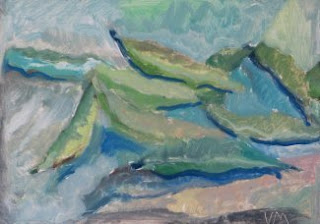
"Post Office with a package"
It's the painting of the peas
Freshly picked, the peas lay on
linen, bunched up to make folds and bumps,
the lumps inside the pods
show where the peas lie
inside their rippled green skins.
It was June. We had just come in
from the garden. At five o’clock
the sun hit the peonies in
shocks of striped light. It was easy
to pick the peas from the vine
on the painted green fence.
Later there would be a painting.
Today a cocktail will do,
a cocktail and raw sugar snap
peas eaten fresh from the vine.
Monday, March 22, 2010
Greenberg
Ben Stiller's pitch perfect line readings reveal the excellent writing of the script. His performance, as well as those of Rhys Ifans and Greta Gerwig, are consistently just right. There is also a remarkable acting job from a dog who it turns out is the most lovable character in the movie.
The movie dares us to warm up to the narcissistic title character. He thinks he is having a party when he serves guac and chips and creamsicles as the refreshments (wait, I think this might catch on). It is hard to believe that the charming Florence played by Greta Gerwig would find anything worth pursuing in this Greenberg who acts weirdly wrong every time he sees her. I wanted to protect her from the boorishness of a man who never grew up (he turns 41 in the movie). Besides he is petulant and crabby. Even, so his concerns are still oddly worth thinking about. I agree with his assessment of Starbucks. And I stuck around to see if the dog would be okay.

Sunday, March 21, 2010
At the Frick

The fingers curl in delicate gesture, keeping a secret. A gold chain necklace hangs out of view. A sleeve has textured embroidery on the cuff. The girl gazes serenely. How different these details are from other portraits of Rembrandt.
Rembrandt Harmensz van Rijn (1606–1669), Girl at a Window, 1645

What are the glass objects just near the maid's hands? The mistress seems dressed to go out, yet she is also engaged in some household business, something looking like the settling of the accounts. The maid has just brought in a fresh receipt, or invoice. A question remains unanswered.
Johannes Vermeer
Mistress and Maid, 1666-1667

Sir Thomas More, 1527
Hans Holbein the Younger

And such piggy little eyes. How could anyone trust a man with a face like this?
Thomas Cromwell, 1532
Hans Holbein the Younger
Saturday, March 13, 2010
Paul Taylor, March 12, 2010
Dance has no words. The dancers move to express themselves.
Here are some of the verbs that might describe Paul Taylor's choreography.
Leap
Explode
Jump
Crawl
Fold
Sigh
Turn
Revolve
Sashay
Puzzle
Think
Decide
Seduce
Repel
Bomb
Primp
Slink
Twist
Reconnoiter
Consider
Cross
Examine
Point
Hide
Slither
Somersault
Backwards Somersault
Rise
Propel
Wave Good-Bye
Since this is his 80th birthday year, there is a feeling of celebration and holding dear the great creative energy we have grown to count on year after year. When he came out to take his customary bow, Paul Taylor looked a little bit shorter than last year. Long may he live.
Syzygy

Brief Encounters


Spindrift

Here are some of the verbs that might describe Paul Taylor's choreography.
Leap
Explode
Jump
Crawl
Fold
Sigh
Turn
Revolve
Sashay
Puzzle
Think
Decide
Seduce
Repel
Bomb
Primp
Slink
Twist
Reconnoiter
Consider
Cross
Examine
Point
Hide
Slither
Somersault
Backwards Somersault
Rise
Propel
Wave Good-Bye
Since this is his 80th birthday year, there is a feeling of celebration and holding dear the great creative energy we have grown to count on year after year. When he came out to take his customary bow, Paul Taylor looked a little bit shorter than last year. Long may he live.
Syzygy

Brief Encounters


Spindrift

Saturday, March 6, 2010
Ghost Writer
Like another thriller, Rebecca, The Ghost Writer features a protagonist whose name the audience never learns. Hired by a recently disgraced ex-prime minister modeled on Tony Blair, Ewan McGregor's character is referred to simply as the ghost. He walks into a position vacated by a man who died by his own hand or was it something more sinister? Things are not what they seem in this movie.
First, there is the prime minister's wife who seems to hold quite a bit of decision making power. She sulks about the personal assistant's relationship with Blair, I mean Lang, which seems to be very personal indeed.
There are clever cuts that lead the viewer to think just a bit ahead of the Ghost, who becomes more and more sympathetic as he seems to be the only honest person in the movie, honest to the point of carelessness. This puts him in danger and lets Polanski demonstrate his finesse for filming paranoia, and McGregor's ability with a clean line like "I'm in trouble."
 What a relief to be in the hands of an expert filmmaker like Polanski who is adept at telling a tricky story without an excess of explosions or noise.
First, there is the prime minister's wife who seems to hold quite a bit of decision making power. She sulks about the personal assistant's relationship with Blair, I mean Lang, which seems to be very personal indeed.
There are clever cuts that lead the viewer to think just a bit ahead of the Ghost, who becomes more and more sympathetic as he seems to be the only honest person in the movie, honest to the point of carelessness. This puts him in danger and lets Polanski demonstrate his finesse for filming paranoia, and McGregor's ability with a clean line like "I'm in trouble."

Marie Ponsot workshop at Poets House, February 27 and 28

Day one.
We write "running dragons" with each other. This is a form Ponsot learned in Beijing.
Alternating stanzas of three lines, then two lines.
Choose one word in the last line of the previous stanza to repeat in the first line of the following stanza. Begin poem with a location, or non-human subject. Continue to write stanzas without a person in mind or implied, until after at least three stanzas. Once you do introduce a person, you finish poem with the same number of stanzas you wrote before the person appears. The last stanza introduces the idea of spring, either explicitly or implied.
Here is mine.
Day after day of rain. The mushrooms bloomed.
Nearby, the Indian pipes had penetrated
the leafy carpet from last year's autumn.
Their vertical stems formed a carpet
over the moss. Is this what they mean
by a fairy ring? Is this what they mean
by enchantment, the nodding white heads
attached to vertical white stems.
Impossible to think they're attached
to the seeds buried since spring.

Some things Ponsot said that resonated:
It is essential to be able to write about the non-human.
Competition and testing are not intellectually respectable.
Learn something by heart every day.
People like to create.
In a crowded life, try Running Dragons (or Dragons Running, the phrase works either way.)
Your world of language is inside somewhere -- you need to get access to it. Write ten minutes every day.
William Blake said "Without contraries there can be no progression."
"The tigers of wrath are wiser than the horses of instruction." (from Proverbs from Hell)
(We wrote revisions and takeoffs of these proverbs as an exercise)
Ponsot's mother was a teacher. Good teachers assign work they cannot fail at.
The challenge of writing is working from the inner life to the spoken life to the written life.
Question: What do you think of self publishing?
Answer: It is important to show your work and have someone show you theirs.
Practice re-writing which is elemental not remedial. Once in a while you get it first crack. Mostly it takes handling, like a potter with clay. Take it into yourself and see if you can say it differently. Rewriting can be productive. Go to the strength, or to the bad knot, and unfurl it. Say it in other words.
Day Two
What is the mystery that makes a poem hit you forcibly in the diaphragm? Here is a poem that does that.
From Shakespeare's Cymbeline:
Fear no more the heat o' th' sun,
Nor the furious winter's rages;
Thou thy worldly task hast done,
Home art gone, and ta'en thy wages.
Golden lads and girls all must
As chimney sweepers come to dust.
Everyone wrote what they thought was meant by truth for the poet.
Another useful technique for poets is to widen the range from the constant I voice to include another person's point of view, either in a dramatic monologue, or as a dialogue, like Stevie Smith's.
Stevie Smith's "The Sea widow"
How fares it with you, Mrs. Cooper, My bride?
Long are the years since you lay by my side.
Do you wish I was back? Do you speak of me, dearest?
I wish you were back for me to hold nearest.
Who then lies nearer, Mrs. Cooper my bride?
A black man comes in with the evening tide.
What is his name? Tell me! How does he dare?
He comes uninvited. His name is Despair.
----------
Marie Ponsot is a wise woman, a great teacher, and an inspiring poet. I felt that I was learning even when she wasn't saying anything.
Friday, February 26, 2010
Snow Day

Snow day
See slide show for more images of Friday, February 26
when all teachers and students had the day off.
Sunday, February 21, 2010


A Single Man
 A Single Man contains one glorious performance, and too many dream-like images of a naked man submersed in water.
 I think my favorite scene occurs when Colin Firth's character comes upon a dog, the same breed as the ones he lost when his lover died suddenly in a car accident, wiping out in an instant not just his love, but his whole family and history for 16 years.
He pets the dog lavishly through the car door window while its owner looks on, at first indulgently, then warily as Firth burrows his nose into the animal's neck and mutters, "They smell of lavender and soap," as if taking a hit of a drug he once depended on. And much as I resented the slow speed of the film and its pretentious lingering on superficial details, I confess that I have gone back in my mind's eye to the scene in the apartment when the two men sat happily together, reading, listening to music, discussing their dogs and silly neighbors.
Tuesday, February 16, 2010
Avatar
What it made me think of --
--all of those movies like Hombre where the infiltrator takes on the values of the alien society
--Gunga Din, the noble savage dying nobly
--how much better a filmmaker Miyazaki is, and his delicious visual palate when the subject is the beauty and vulnerability of the earth
--cowboys and Indians and how great a director was John Ford
--every ordinary war movie and some really good ones that have this one beat (Das Boot, Galipoli, Empire of the Sun, Casablanca)
--Apocalypse Now (Duvall coming in to beat down the savages)
--Alien with Sigourney Weaver holding her own among the testosterone
--Titanic, and other disaster movies on an epic scale (the big tree standing in for the big boat)
--adolescent boys' fantasies and little boys' miniature soldier sets and GI Joe
--Star Wars and the disappointment of watching a conventional war movie.
What I really like about movies is the human part, and how good acting can tell a story simply. But first you have to suspend your disbelief and see the characters and situations as believable. These characters were wooden, reciting familiar lines ("They are fighting modern warfare with bows and arrows!"). While watching what I was most aware of was how expensive and long the movie was.
 I guess that James Cameron wanted to do what Kevin Costner did in Dances with Wolves. Okay. So that is why the movie feels so flimsy and so expensive at the same time.
--all of those movies like Hombre where the infiltrator takes on the values of the alien society
--Gunga Din, the noble savage dying nobly
--how much better a filmmaker Miyazaki is, and his delicious visual palate when the subject is the beauty and vulnerability of the earth
--cowboys and Indians and how great a director was John Ford
--every ordinary war movie and some really good ones that have this one beat (Das Boot, Galipoli, Empire of the Sun, Casablanca)
--Apocalypse Now (Duvall coming in to beat down the savages)
--Alien with Sigourney Weaver holding her own among the testosterone
--Titanic, and other disaster movies on an epic scale (the big tree standing in for the big boat)
--adolescent boys' fantasies and little boys' miniature soldier sets and GI Joe
--Star Wars and the disappointment of watching a conventional war movie.
What I really like about movies is the human part, and how good acting can tell a story simply. But first you have to suspend your disbelief and see the characters and situations as believable. These characters were wooden, reciting familiar lines ("They are fighting modern warfare with bows and arrows!"). While watching what I was most aware of was how expensive and long the movie was.

Monday, February 15, 2010
Crazy Heart

Jeff Bridges has played a character sort of like this before, in the Fabulous Baker Boys. In the earlier movie, his bad boy piano player worked those sad piano bars in the lounges of second rate hotels. In
Crazy Heart, when he works in seedy little joints to sing his country music, it doesn't seem as depressing. It seems authentic. The Baker Boys didn't have to sing, just play, the old standards. Bad Blake, his character in Crazy Heart, wrote all his songs of heartache that he is still living through.
The movie centers on a broken down 57 year old talented drunk named Bad Blake and whether he can get his act together before it is too late. He had had success on the road with another musician, Tommy Sweet (played by Colin Farrell who strangely is not given top billing even though he is an important part of the plot, and has some of the most satisfying musical scenes with Bridges), who is now more successful than he is, and younger, and better looking, etc. causing all sorts of resentment and wounded pride.
Maggie Gyllenhaal plays Jean, a journalist who enters his life when Blake is working a small club in Santa Fe and she approaches him for an interview. The softening of Blake's crusty character brings some tender moments to the movie, with Gyllenhaal and her slow flirtatious smile that fills in for a host of emotions. She is an attractive person to watch, with great physical appeal, and when she gets mad, as she must in this film, she is very fine.
I loved the way the two men sounded when they were singing, and I loved the way Robert Duvall can act circles around anybody just by standing still. In this movie, he gets to sing a little too. And it is a beautiful thing.
Friday, January 22, 2010
The good thing about losing your memory
forgotten science is discovery regained
I just learned something new
or did I learn it before and now can claim
it as my own again
Where do the old memories go
Are they washed away like silt down the river
Or do they vanish in a cloud
Carried away on the breeze
My mother wants to know
what I’ve been up to.
I consider my report:
writing is so boring.
Theatre lacks a frame of reference.
So I say at first nothing special,
just taming lions,
flying solo across the Atlantic,
writing my acceptance speech
for the Nobel Laureate,
learning to juggle with knives
translating simultaneously
for the peace negotiations in the Middle East…
the list is so long she grows bored
and says she has something on the stove.
Subscribe to:
Posts (Atom)