La Danse
Saturday, November 7, 2009
La Danse
La Danse
35 Rhums
The movie unfolds with the slow pace of real life and the risk of boring its audience. We watch real trains in real time come and go through the suburbs with nothing visually arresting to keep our attention, just the usual jumble of wires and train tracks and cereal box buildings.
The main character, a middle aged single father named Lionel (like the train set), lives with his beautiful young adult daughter who attends university in Paris. Lionel says little, but his still face expresses his concern for his daughter's future, I think. Their relationship is so loving and intimate that you wonder if they are sleeping together, but no, it's just the tension that builds as they determine what they should do for each other to set each other free.
There is one scene that finally reveals how the reticent man is feeling. Denis, the director, clearly loves the way this beautiful actor looks, getting in and out of his bathrobe. And so do other women who cotton to him even when there is evidently nothing tying him down to any of them. He has come to the restaurant with his daughter and a friend, and then hits on the waitress who is younger and more beautiful than his friend.
As they dance, you see how the father has desires just like any other man, and the audience intuits that he wants the daughter to experience and enjoy them too.
Saturday, October 10, 2009
Saturday, October 3, 2009
Museum of the Chinese in America
The museum is as crowded as the neighborhood. Maya Lin's design lends elegance to its rooms which unfold one from the other, beginning with the early immigrant experience and its blatant racism and exclusion acts. On opposite walls you can read the achievements of individuals, like Ah Bing
who discovered how to hybridize the perfect cherry, and
Anna Mae Wong,
whose inroads into Hollywood were spoiled by her exploitation. You experience post WWII anti-Communist fifties by sitting on an old arm chair and watching a 1950s era tv show about the hounding of Chinese in Chinatowns (the authories assumed that they were Communists). Modern stars of contemporary culture include Steve Chen, the inventor of Youtube, Yo Yo Ma, and I.M. Pei.
One of my favorite discoveries was Dr. "Mom" Chung, the first Chinese American woman physician who served during the Second World War, and liked to dress as a man and dated among others Sophie Tucker.
I wish that I could process everything at once, but was overwhelmed by listening to overlapping audio and watching moving images from three different projectors. The print on the placards is tiny. I felt old and incapable of taking it in. Next time I will bring a magnifying glass.
At the end, in the Bloomberg Exhibit Hall was an ongoing loop of movies, called the Chinatown Film Project. I will have to go back and watch the ten short movies which progress in linear fashion, one at a time.
And the paintings by Yun-Fei Ji are marvelous. It is a pleasure to go into an open space and see paintings spread out at their ease.

The Scholar Flees in Horror by Yun-Fei Ji
Monday, September 28, 2009
Bright Star/directed Jane Campion
With a magnified needle piercing a piece of muslin. we are instantly drawn into this sensuous movie. I remember Campion's ability to startle all of my senses in The Piano, and with sudden twists of plot. Here she is telling a story of love experienced by a great poet, John Keats.
I loved the clothes, the little girl with the cloud of red hair who played Fanny's little sister named Toots, the actor who played Browne, a perfect dog in the manger, the cat, the flowers, the butterflies, the way we get a taste of daily life in the early nineteenth century through the deliberate pacing of scenes, and finally I love the way the film sends you home to read Keats (or the letters of Fanny Brawne which prove that the film is very well sourced).
Sunday, September 27, 2009
Saw a girl that looked like her
She was tall and thin
She carried herself in a way that said
I don't care what you think but I know that I might be worth looking at
When she bumped into someone by accident she said Oops sorry
She was wearing boots
A pair of jeans with holes in them
She was eighteen
Vermeer's The Milkmaid
Saturday, September 26, 2009
Saturday, September 19, 2009
Julie and Julia
After the movie credits roll, what we search for is a recipe by Julia, not the blog by Julie.
Alas for Julie. Hurrah for Julia!
Friday, September 11, 2009
ponyo

ponyo
A girl goldfish sees a human boy and is smitten. Determined to become human herself, she flees the strict rules of her father and hundreds of look alike siblings*, and finds that she has the power within herself to not only become human, but much else. The beauty of Miyazaki's animation comes from the hand made color saturated pictures, and the humorous movements of the protagonists. Ponyo once she determines she needs feet to be human, starts out with three toes like a chicken, and later gets a full set of five which liberate her to jump on couches etc.
Miyazaki's subject is saving the earth from the wickedness of humans' carelessness and waste.
*

Monday, September 7, 2009
making creme brulee
I got the recipe from Epicurious which does not carry the classic recipe without lemon, or coffee, or chocolate, or whatnot. This is typical of epicurious. They specialize in the rather showy trendy food fads, forcing you to strip away things in order to get a basic recipe.
Still, there is nothing more comforting than custard with a crust of caramelized sugar on top.
how to make creme brulee

photo from Flickr at
anne&ming
Saturday, September 5, 2009
September 5, 2009: Seasonal
I love to buy fish at the greenmarket on Saturdays in Tribeca. There is always a line at Blue Moon fish because Alex Villani brings in such fresh spanish mackerel, scrod, scallops, you name it. Here you can see him talking at his stand which gives you an idea of his personality.

Alex Villani of Blue Moon
The apples are coming in after a few weeks of nectarines better than peaches. Honeycrisp is the name of an apple favored by my husband because they were discovered in his home state of Minnesota.

St. Luke's Garden was bathed in bright light today. After tanning on Elizabeth's bench, we looked at the flowers in blossom, and were struck by the bright pink flowers that look like lilacs in miniature but may be crape myrtle. It is tempting to go inside and visit the columbarium, but it is closed until services tomorrow.

photo by omoo
Friday, September 4, 2009
Why I Love Tennis
the women are able to show their curves without displaying so much flesh and you get to watch them move easily in their fitted outfits. It combines running and jumping and hitting
The Williams Sisters, one full of soul

the other fire and precision and competition

and of course there is Federer whose footwork
was compared with Fred Astaire's


It's the shock of Rafael Nadal's constantly picking at his underpants.

and Federer's mystique as the man who does not sweat, each attribute intimidating in its own way

but the love for the great competitors who can bring out the best in each other is very moving the longer the game lasts.
Roddick and Federer this year at Wimbledon.

Maria Sharapova and her sense of style and hauteur.
The way she lifts her nose as if she smells really good
when she makes a point.

(I do not like the loud noises she makes
when she hits the ball. Sounds like somebody having rough sex.)
Mostly I like the prospect of another Nadal Federer face-off, the most amazing event in sports I can remember. Like a perfect game in baseball. Rare and welcome.
Still Walking (Aruitemo Aruitemo) dir. Hirokazu Koreeda

Hirokazu Kore-Eda is a visual artist, but what stays with me are the beautiful lines he writes in his film about a wayward son who returns home to visit his aging parents one summer day with his wife and stepson. The movie is about living after the death of an important family member. The parents grow bitter, the siblings shift into their roles as not as good as might have been.
As all three generations of the family gather to honor the anniversary of the eldest son's death, the story unfolds with the humor and sorrow of a Chekhov play. Everyday actions, like preparing meals, are visually wonderful. You can almost smell the corn as the tempura is scooped out of the pan and into the eager mouths. The acting is flawless, particularly by Kirin Kiri who plays the mother, a woman who has mastered the art of spite.
Kore-eda is also the director of Afterlife, a sublime treatment of life after death.
Tuesday, August 25, 2009
A bat became fastened inside the piece of siding of the house.
His little hooked talon which attached to his wing could not free itself.
He struggled and flailed and could not fly away.
He began to gnaw at the wing to detach it.
Drops of blood fell on the side of the house.
My sister bought me a table to climb so that I could reach.
With a wedged stick the siding came free and the bat
fell downstairs to our neighbor's welcome mat.
He was exhausted and bloody. He
hopped along into the net. I freed him into the wood
pile. I wonder if he will live or not.
My sister wanted to put him out of his misery
as we used to say. (Drop a rock on him.)
He was suffering and squeaking but still alive,
last seen in the wood pile.
Friday, August 21, 2009
Friday, August 14, 2009
They’re having a perfect woman sale
at the Walmart. She comes in a box
with movable parts
She doesn’t say much
Just yes and you’re right
when you pull the string
She looks good with her make up in place
and doesn’t grow old
She doesn’t make mistakes
or ever lose her temper
Go ahead
Take a ride to the Walmart
They’re selling perfect women there
Sunday, May 10, 2009
Feminist Video at the Brooklyn Museum
Kate Gilmore (American, b. 1975). Still from Blood from a Stone, 2009. Mixed-media sculpture with video, color, sound, 8 min. 9 sec. Courtesy of the artist and Smith-Stewart, New YorkKate Gilmore's lifting the big blocks of white and placing them just so on the ledge has a repetition and monotony broken by the white paint that bleeds down in irregular vertical lengths.
The weed whacker wears a nice dress and shoes as she clears a patch of grass too big for that tool.
Harry Dodge (American, b. 1966) and Stanya Kahn (American, b. 1968). Still from Whacker, 2005. Video, color, sound, 7 min. 7 sec. Courtesy of the artists and Elizabeth Dee, New YorkAlso saw the Dinner Party, and studied some of the exhibits that accompany it. Again, it is intended to teach a lesson. I guess we need the lesson, but I prefer my art without pedantry.
The Dinner Party by Judy Chicago
Sunday, May 3, 2009
PEN World Voices Cabaret
Nick Laird read from his poetry books, To a Fault and On Purpose. He was self effasive and charming. He referred to a John Berryman poem as being written 35 years earlier that was better than his poem.
Horacio Castellanos Moya read from his novel in Spanish. The excerpt said that he was not completely in his mind having hired himself out to the Catholic Church to translate a document responsible for many of the troubles he was then in. A drummer accompanied him. A translator read in English.
Steve Connell and Sekou the Misfit did a duo slam rap.
Parker Posey and other acting notables did a performance of the New York State segment from State by State edited by Sean Wilsey.
And of course, Lou Reed whose Metal Music Machine is his focus now to the point where he is almost unable to articulate anything in words, had Laurie Anderson with him. Anderson's performance of "Only an Expert" was powerful.
Friday, March 20, 2009
Palace Yurt

I never realized how many applications felt could be put to until yesterday when attending the Fashioning Felt show at Cooper Hewitt. Mongolians make felt with raw wool, spread out on "mother wool pads" then moistened, rolled up, and hauled around the flat ground by camels or horses until the agitation creates a joining of the many threads to a single sheet.
Above is a picture of a "palace yurt" created with silk and felt and installed in the conservatory where sunlight filters through the diamond patterns the artist Janice Arnold made.
Another artist made her wall of felt dyed with madder and St. Johns wort -- vivid orange and red hues that attracted me like a magnet, made me want to rub up against them. She had designed these as a cure for melancholia.
Tuesday, December 2, 2008
Inventory
knee socks
thirty t shirts
the one with the pig snout
the one from the St. Anne’s invitational tournament
many with holes
some with their sleeves cut off
pajama bottoms
some with clouds
some with snow banks and Eskimos and polar bears
the two t shirts with Gorey quotes unopened in their plastic wrappers
the pair of corduroy pants she didn’t like
the French linen pants she never wore
the letter she purloined from my records
with the picture of grandpa and George Bush senior
when they were both around 40 and looking
like minor players in a James Bond movie
she really loved James Bond
he was her kind of hero
or was it just that he was mad handsome
and could get things done
The dresses and skirts and shirts and scarves that hung on the rack
I sorted and put in two piles
first the ones to throw away
then the ones to give away--
no I needed three piles--
the ones to keep or give to friends--
now I have four piles-- the ones I will sleep in--
I put the ones to give away in a box--
there are three skirts, two dresses, the pants,
some t shirts and sweaters
and four handbags –
how she loved handbags
the green one that zippered,
the rose patterned clasp.
I open the bag.
Inside is a receipt from the Salvation Army on E. 23 St.
dated October 22, 2005. I decide to go there.
I carry everything to the taxi.
The driver knows of the Salvation Army
on 14th and 26 but I want to go to the one where she was.
It is the day after Thanksgiving, black Friday
they call it.
The traffic is heavy at 23rd St.
I see her ghost at the Gap,
on the corner of the Old Navy store
where we fought over what she wanted to buy
versus what I wanted to pay for.
I suddenly become very hot and pull off my coat, my scarf,
the sweater I knit her so hot like a flash fever.
The driver says where is it?
as we pass the Good Will;
I think I could just go there,
but no --I want to go where she went and then I see it,
the red outline of a kettle and I say to the driver here it is.
You can stop here.
I pull my clothes back on and pay him. In the door are a few clothes racks
with nothing of interest and a sign saying -- more downstairs.
Someone takes my box-- I have folded the flaps
but it bulges, the last dress I put in shows through--
a red and blue 80s power dress with a gold belt--
is suddenly not hers anymore--
it’s just some discarded stuff --
something she would have trolled for --
that little flash of color showing through the box
like Rosebud in Citizen Kane’s basement -- fades away.
The meaning changes once it is out of her room.
It can mean nothing now.
Saturday, November 29, 2008
Sunday, November 23, 2008
Grandmother’s Basement
Another room in the basement holds the root cellar where during the war years when everyone had a victory garden, Grandma did her patriotic canning. I love the photography equipment she keeps here—an enlarger, and hand tints to color in the pupils of her subjects’ eyes, the blush on the cheek, the color of their hair. Her paintbrushes sit unused on a coca cola tray. When is the last time she used them I wonder? Now she keeps hordes of snapshots in albums, kodachrome pictures of the family, in vivid color.
Everything in the basement speaks of a black and white era, especially the photo process. Our closest relatives in family films of move as jerkily as the silent movie actors like Chaplin not because of the speed of the camera. It is the unease of being observed closely, of being expected to move in a way that would amuse the audience. People move in fits and starts. We never know what to do when confronted with the movie camera. We look up with shy eyes, wave or gesture awkwardly. Grandma always shoos the camera away and turns quickly from it.
The exception to the black and whiteness of the basement is the ball. It is clear plastic, an early version of thick plastic polymer that slowly loses its air every year-- we re-inflate it with a hand pump used for bicycles--clear plastic flecked with many colored specks. The colored specks are parallelograms, and they make the thing festive and very desirable to us children, as desirable as the cartoon characters on Grandma’s band-aids she keeps in a small water closet off the kitchen. In that medicine cabinet are other alluring trappings of being sick and injured—St. Joseph’s orange flavored aspirin---as delicious as candy.
A perfect day at Grandma’s would begin reading the comics in the wooden chair with red and black cushions in the game room. Play checkers with your sister. Get into a fight when she tries to cheat.
No one could hear us down there. The grown ups were upstairs having cocktails or telling boring stories about their childhoods or arguing about the Yankees or politics, or Vatican II and Pope John the xxiii. Why would anyone want to hear the Mass in English?
After we got bored and Mom told us to go outside and play we found the ball and went outside to play kickball. By this time our cousins had arrived, all six of them, the children of Dad’s brothers—Philly, Joy, Amy, David, Ned and Susan, which combined with our five were enough to make two teams with the help of some willing grown ups. It was good to have Uncle Philip on your team. Dad‘s youngest brighter was funny, made us laugh. He didn’t mind playing kickball with us kids. Dad would stand in as pitcher, hurling the clear plastic ball over and over again, with the same dead aim as he bowled, right at the pins, or in this case, us children.


Friday, November 14, 2008
Heavy Lifting
young person brushes past me in a hurry.
I pull on the railing one step at a time
but coming down, first one, then two, and yet a third
parent bear strollers lifting their heavy loads
to get to the train. Such are the jobs we do
as parents, getting our children from here to there:
to doctor, to grandparents, to pre school,
and then out of the stroller, not carrying
the actual child, but holding her hand
as she learns to look left and then right,
at the street lights, at the intersection,
at the junctions of her life.
After ballet lessons we always stopped
and had an orangina and a croissant.
Elizabeth would peel the fine layers of the pastry
one at a time letting the buttery dough melt in her
mouth until she had stripped the thing down
to its chocolate center. It was our Saturday morning
ritual. No heavy lifting required.
Thursday, November 6, 2008
Lucille Clifton at Uptown Y

Lucille Clifton read poems from her new book, Voices. She talked about the importance of naming and knowing our own names.
We hear from the man on the cover of the Cream of Wheat box, Aunt Jemima, and Uncle Ben. What if they all took a walk together?
Cream of Wheat

sometimes at night
we stroll the market aisles
ben and jemima and me they
walk in front remembering this and that
i lag behind
trying to remove my chefs cap
wondering about what ever pictured me
then left me personless
Rastus
i read in an old paper
i was called rastus
but no mother ever
gave that to her son toward dawn
we return to our shelves
our boxes ben and jemima and me
we pose and smile i simmer what
is my name

from Voices by Lucille Clifton
Saturday, November 1, 2008
Thoughts in Autumn
of russet, orange, and red darkening into brown
I learned to call maroon when I was ten,
and driving with my family in our car
to look at leaves and buy some apples
and dusky concord grapes that grow in the Finger Lakes,
our Umbria, our Grassmere, our nirvana of New York State.
It's one thing to go to school, your pencils new,
your shoes unscuffed and shiny,
it's another to see your children leave the house
and return you know not when
Trouble the Water

Kimberly Rivers and her husband Scott Roberts, living inside the storm, take us through their streets, their neighborhood. At one point we are with them when they are stuffed into their attic and the waters of Hurricane Katrina are rising. They are our tour guides to hell.
How distanced the early responders were to the poor, disenfranchised residents who were in need. How disgracefully all levels of government behaved. It is easy in hindsight to understand the neglect. But we are living in the moment in this film whose witness is a strong indictment against Bush whose war time priorities and incompetence kept him from saving those who were dying in the United States.
It will be hard to think of Bush as a compassionate man again when he turned a blind eye to the people of New Orleans. One of those displaced described her feelings: "It is as if we are not citizens."
Tuesday, September 23, 2008
Expectations of Adulthood
the knee socks and emblem on the weskit
set us apart from the children
in public school who could wear jumpers
or leotards or whatever their mothers chose.
Sometimes we played baseball near the grotto,
the statue of the Virgin always close,
or mimicked the speech of our parents.
Nixon versus Kennedy, differences arose.
Sister Mario taught music, urged us to use
soap not shampoo when washing our hair.
We mustn’t smell too good. Shampoo
makes you vain, her dark eyebrows scolded,
the only bit of hair not hidden by her wimple.
I would be a god.
I would be perfect,
and when I died
they would build a shrine.
I would run the bases
every single time.
In the painting at my grandmother’s house,
the cardinal in red biretta, the parrot squawking
through his study, the skull on the desk,
seemed to give the solution
and the solution was art.
I would find the reasons
behind every single lie.
I would win a prize.
I would never die.
Friday, September 5, 2008
I Used to Think
I used to think when people died their images would fade,
their color pictures change to black and white then grey,
their spirits hover like the light at nightfall.
After his fatal heart attack, I felt Walter tethered
to the earth, revolving like a moon in orbit
or were we revolving around him
who felt alone out there?
But when you died I saw nothing.
The sun eclipsed, the moon
went dark, and an absence grew
so vast a continent appeared where I now live.
Monday, September 1, 2008
because George W. Bush was scheduled to speak at the Republican National Convention.
I Dream of George W.
In Egypt at the foot of the Sphinx.
Vast expanse of desert and dunes.
In the far distance, office towers,
the skyline of some city of over a million.
As I move along with my tour group,
a projectile whistles past my ear.
The skyscrapers vanish, and in their place,
a mushroom cloud and flames.
Another explosion flattens the rest of the city.
Nothing is left. Holy shit. Holy shit.
Later. another dream.
George W. Bush has come for dinner.
He will only eat a certain kind of potato
and when I fix it he winks at me.
I feel like France during the second world war.
Mostly I want to eat drink and be merry,
might take up cigarettes again to help me face the firing squad.
Will I be killed for something the military
did over which I had no control?
How many more Iraquis will die for something
in my name? Will today be the last day
of my life?
Tuesday, August 26, 2008
I Want To Swim To Work
descending down the tunnel like a drone,
then later huddled on the bus with jerks
who broadcast when they’re on the phone,
you’d know I don’t exactly want to shirk
my duty as to be alone.
Deep down I am a country girl at heart.
Mass transit was a challenge from the start.
In Syracuse, where I grew up upstate,
my transportation usually meant the bus.
Let’s say your curtain’s set to rise at eight,
when evening schedules slow to a crawl,
and you cannot risk coming late.
With no subways, trolleys or vespas,
the only way to get from here to there
meant filling up the tank to drive the car.
In Manhattan, I learned to take the train
and not to land in Brooklyn by mistake.
My entry level job was to retain
what customers we had who bellyached.
The sample issue of the magazine
was something they refused to pay or take.
We signed the cards with names completely sham:
Yours sincerely, Virginia Cunningham.
(In the backseat of a cab suddenly you are
stuck on the upholstery of an idling car--stuck in a bottleneck)
I love my three speed bike. Weaving at noon
between the cabs, leaving them in my wake,
I speed downhill outside the tunnel traffic.
Just now, I pedaled to the market
where I bought leeks, potatoes, melons
then onto the butcher, the library, all done.
Swimming downstream in rivers takes
less muscle than swimming in a pool.
My arms and legs stretch out like superman's,
then coast, my torso thin and high and tense
to keep from bumping into rocks that jut
and but my shins in shallow water. I swim
in as little as a thimble of water when I get into the groove.
But since the Hudson's all upstream,
and the East River filled with toxins,
between my house and where I work
I will go on taking the train,
then boarding the bus, or fetching a cab
or riding my bike, ending always as
a pedestrian, crossing the light
on the green while I dream
of the river that lets me swim downstream.

http://www.flickr.com/photos/zoom-in-tight/2724208943/
Sunday, August 3, 2008
by Penelope Cake
chashama performance window
Between 7th and 8th Avenues, A/C/E/1/2/3 to 34th Street, N/R/Q/W/7 to Times Square; M16, M34 buses to 8th Ave, M10, M20 to 36th St.
Opening reception and performance: Sunday, August 3, 5:00 – 7:00 pm
Additional performances:
Tuesday, August 5th, 1:00pm
Thursday, August 7th, 5:00pm
Saturday, August 9th, 7:00pm
FREE and open to the public.

The beauty of a public window is how haphazard the audience is. Men draw back shy of the sudden movement of genuine dancers behind glass. Women lean forward, attracted to the ten year old girl who dances with Miss Cake completely deadpan. They balance books on their heads, set the table with fork and knife, and perform other domestic rituals with ironic gestures. In the background is Cass Collins, ironing red and white checked napkins. Sometimes she irons the wall, which has its own white and red checked cloth.
Thursday, July 17, 2008
New Poet Laureate Named: Kay Ryan

Watch her and read more about her and by her
Library of Congress Announcement
Death by Fruit Kay Ryan Only the crudest
| ||
| 1 August 2000 ©2003 Partisan Review Inc. | ||
Wednesday, July 9, 2008
Herzog's Encounters at the Edge of the World

What is it about Werner Herzog's voice that makes his commentary go down so smoothly throughout his documentaries? The subject is always not just the subject but also his relationship to it. Here he is at the South Pole, interviewing a woman who studies seals milk (if you let it cool it would be like paste and you couldn't pour it). The seals lie on the ice indolent as hollywood starlets sunbathing poolside. Suddenly a scientist puts a plastic bag over the mother's head to extract her milk. She doesn't move, but tenses up and makes a noise.
Later, the scientist describes the noises the seals make underwater, a series of clicks and explosions, and unearthly music, as they travel and seek each other.
The penguins Herzog objects to, having seen too many of them already in the other cute endearing movies of recent years. So he finds a penguin who is deranged or just not interested in surviving. We watch it as it walks in the wrong direction to certain death.
We also meet a joyful scientist whose research is the iceberg which is constantly shifting, and another man who studies single cell organisms, a man made happy by the neutrinos that will be captured in the strastosphere by a helium balloon.
The scientists are travelers -- if you shook the world upside down, the people who were left would land here on the south pole.
But Herzog is most akin to the forklift operator who is also a philosopher. When he was young, his mother read the Odyssey to him, and he fell in love with the world, and has been traveling ever since.
Herzog's Encounters at the Edge of the World
Tuesday, July 8, 2008
Munch’s Death in the Sick Room
to the ground, to the right, to the wall.
It is too much to bear. First she was sick.
The bottles of medicine sit futile on the mantel.
Bedclothes lie twisted and soiled.
Brother holds on to the wall.
Father’s grey hair points to the floor.
Sister clasps her hands and prays to a god not here.
Only you stand upright, dark circles under your eyes,
your eyes that stare straight at me.
You do not say anything with your grey lips.
Mother already attends to the corpse,
She knows this is an important thing
for the living to do, to tend to the body.
Your face, your single gaze, not in farewell, just
simple eye contact goes straight through me.
Sunday, June 29, 2008
What I'm Angry At Today
The new owners have a yorkie.
I am afraid of yorkies.
Once I was bitten by one.
It lunged at my leg and left a scar
from its tiny sharp teeth.
I go in the pet supply store
to buy cat food. The yorkie is sitting on the counter.
While paying the bill, my hand comes
perilously close to the yorkie's jaws...
Wednesday, June 18, 2008
Noise
the heavy loads of sheet rock.
Could someone please oil the rusty joints?
The garbage truck yammers and haws and vibrates
with its smelly jaws that open and shut and clamp
on the discarded mattresses and gigantic slabs of waste.
Below my feet there is a boinking
and sudden lifting of a squeaky hinge
as workers use their screw guns to install sheet rock.
The cat dashes under the bed when the lightning cracks.
We watch the jagged trace of electricity.
The water rushes then pools on clogged drains.
Car alarms go off from the super charged air.
Here comes a fleet of motorcycles!
Beefy men in round helmets hold their arms
as far apart as they can to brace their jacked up handle bars.
The farting engines thunder down the street.
Could someone tell them to turn off the screaming eagle
sound effects of their exhaust systems?
They're tearing up the street again
with jackhammers, a combination of
TNT-type explosions and the whine of the dentist's drill
Could someone please come up with a quieter way
to get into the bowels of the street and the pipes
and recalcitrant electrical wiring that goes wrong down there
without a lot of banging and clatter and uproar?
Why isn't it easier to slice open the hole in the ground?
Con Ed, are you listening?

photo by Daniel Carrus
Thursday, May 29, 2008
Evening Commute
a man has hoisted onto his shoulders
two large plastic sacks.
They are crammed with cans worth five cents each.
His hair flops over his eyes. We make no eye contact.
He mutters as he walks past a woman
carrying a plastic baggy turned inside out
for the droppings of the poodle trotting
ahead of her. All the streets have trees
up here. Planted around the trees are pansies,
and around the pansies a short fence.
Doormen wash down sidewalks every morning.
They pause when I walk past, but now
it is night and I am heading to
the bus then the subway to
Chinatown where an old woman has slung
eight square plastic jugs on a pole.
She has braced the rod across her back
and balanced it on her shoulders.
Men facing east kneel on prayer rugs
on the sidewalk in front of the old bank
now a Payless Shoe store.
There are shops with bootleg perfumes by Chanel,
Calvin Klein, Guerlain. There are plastics stores,
there are men selling sound systems,
and women selling handbags.
The four men who had been praying to Mecca
roll up their rugs and push their wares in suitcases
on wheels. I wonder what is inside.
The old woman rattles a coffee cup's loose change
She looks down as I pass her.
I am almost home now.

photo of Canal Street
By Sergio Calleja
Monday, May 26, 2008
Olive Kittredge
Haunting stories stay with me today after having finished the collection last night. The collection of short prose pieces centers on a large boned woman whose husband is her counterpoint--soft hearted, generous, gentle. Olive is brusque and does not suffer fools. The stories that are not about Olive are also character driven, with one of the most heart-rending about a teen with an eating disorder. Even when Olive is not the only one holding our undivided attention, she is often in the periphery or remarked on by Olive's neighbors who become the focus of the ancillary stories.
The setting is a character in its own right, the small town in Maine where the Yankee disposition of keeping a stiff upper lip and holding your secrets to yourself is beginning to be chipped away by the openness of celebrity culture and psycho-therapeutic solutions of the early 21st century. We witness Olive in her middle age, and as she advances in years, only to suffer a rift with her only child.
Imagine combining the sensibility of Ray Carver (without the drinking) and Alice Munro. You might begin to feel the strengths of this marvelous writer.
Wednesday, May 21, 2008
Jee Leong Koh

Payday Loans, poems by Jee Leong Koh
(Poets Wear Prada) Hoboken NJ 2007
I encourage you to buy this book, but please go to the poet's blog to buy it, and to find the many stimulating things he has to say there.
In a series of sonnets, Koh writes of his struggle to find a job.
Every poem is about waiting: waiting to get a job, waiting to move in with his boyfriend, waiting to write the great poem. Koh is an expert sonnet maker. The sequence was written after Hurricane Katrina and I like the self mockery of this poem.
April 27, Wednesday
I can’t decide which organic bread to buy,
the pumpernickel or the multi-grain.
The tents of death still fly on flooded plains
and campers pray for drops of food supply.
I can’t decide which organic bread to buy.
The fucked-up prisoners-of-war complain.
The pumpernickel or the multi-grain,
I ask the empty counter. No reply
but the new pope speaks out against the tie
of gay marriage legalized in Spain.
The prisoners protest for checkout lanes
and campers pray to satellites that fly
over their heads while I decide to buy
the pumpernickel, or the multi-grain.
Laurel Blossom
I raced through Blossom’s Degrees of Latitude because the structure—traveling through latitudes—and the form --in free verse— had the suspense and tension of a page turning novel.
The plot does not unfold so much as surprise the way a good lyric poem does. And there is expert use of dialogue. The mother - daughter relationship develops in a few pages, from birth of daughter to death of mother with quick brushstrokes.
The book's melding of forms breaks new ground. I hope that it gets the wide audience it deserves. Several of the characters are alcoholics and Blossom's writing in these passages is more appealing to me than anything O'Neill has written.
Here is an excerpt:
____________________________________________________________________
My husband said he thought the spinach wasn't quite done.
When I looked I saw I'd served it to him straight from the freezer, a hard green brick.
That was the night I knew.
So I tried white wine.
So I tried divorce.
*
Two bottles of Wild Turkey, a bottle of Teachers, a bottle of Canadian Club one shot down, a bottle of Stolichnaya, a bottle of Gordon's Gin, half a bottle of Beefeater's for Peter, an unopened bottle of Ron Rico because nobody seems to drink rum any more, a bottle of Grand Marnier, a bottle of Metaxa, a bottle of vin santa in honor of Aunt Phoebe, a bottle of saki Gloria gave me who loves sushi, two decanters, one full of Scotch, the other full of brandy, one a wedding present from Freddie's uncle, the other my mother's doughtnut-shaped beauty, the last bottle of white wine, three bottles of red, a bottle of Harvey's Bristol Cream.
The sink smelled wonderful.
from Degrees of Latitude a poem by Laurel Blossom
May 10, 2008
Saturday, May 10, 2008
PEN America World Voices Festival
The theme of the World Voices Festival this year was public lives, private lives. Salman Rushdie introduced eight writers from Hungary, South Africa, UK, Israel, Germany, Mexico, and U.S., who read in their native languages. It took all my concentration to watch the words scroll on a large black screen behind the reader especially when the scrolling didn't keep time with the words, but how wonderful it was to hear the languages and to see the writers come from many places.Annie Proulx modestly read a short story by Irish Aidin Higgins who was not able to come because of fragile health. Here is a link. She read it beautifully.
Annie Proulx from Aidan Higgins’s Langrishe, Go Down
Most amusing was Peter Esterhazy's Celestial Harmonies, about his Austro-Hungarian family. Book one of the larger work is entitled ""Numbered Sentences from the Lives of the Esterhazy Family." Here is the first of many sentences.
1. It is deucedly difficult to tell a lie when you don't know the truth.
Monday, May 5, 2008

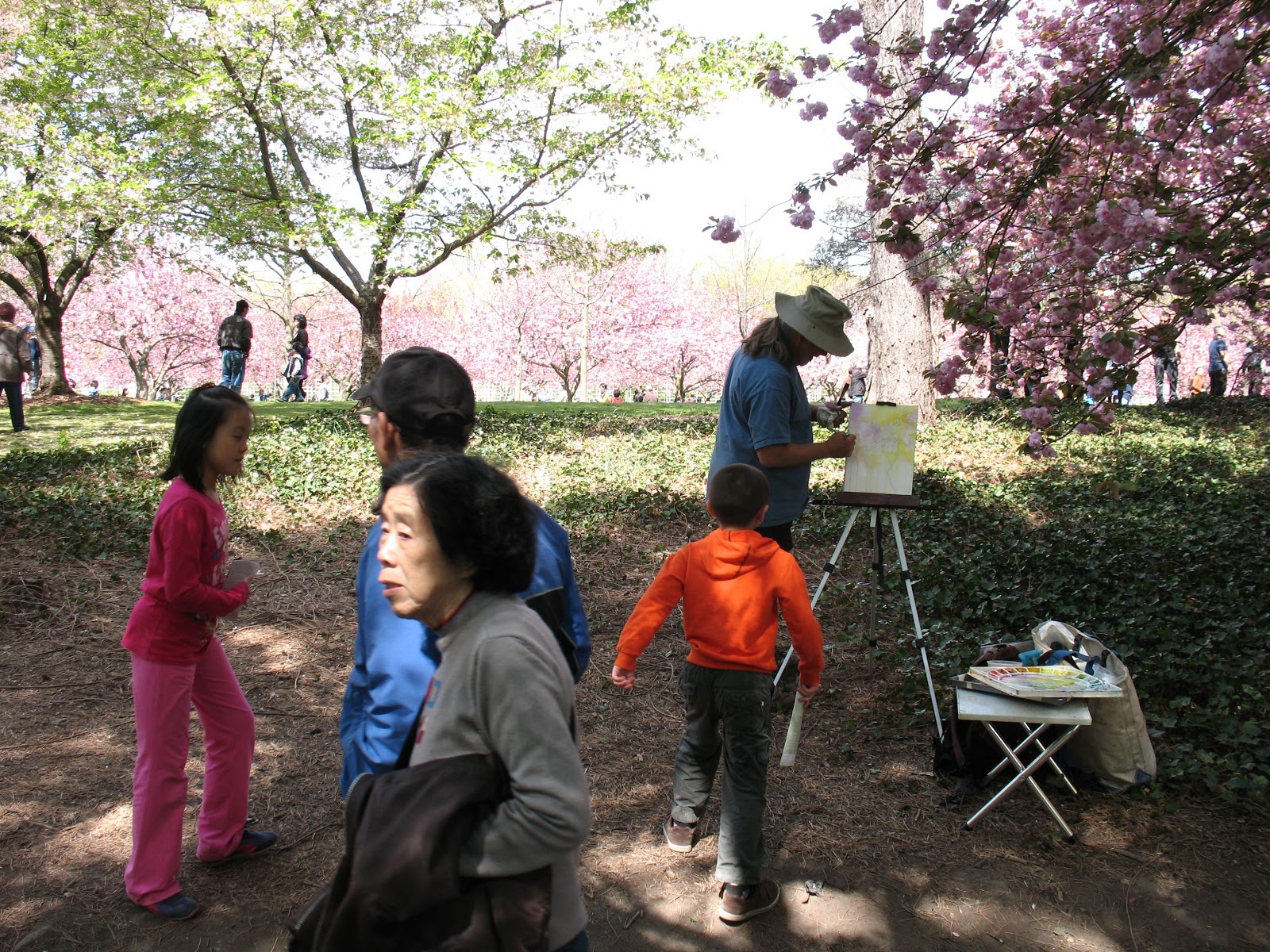
Richard and I went to the Brooklyn Botanical Garden and ran into the Cherry Blossom Festival. So many pink petals. So many children running across the lawn.
As we walked down the main alleyway toward the loud canned pop music stand blocking the steps to the cherry tree esplanade, we passed a young boy and girl. The boy who was a little older than his sister was poking her, then dodging out of her way so that she couldn't get back at him. After this happened three times, the grandfather stood between them, took the girl's hand and walked away.
Among the lilacs, Richard found the paler blossoms more fragrant. I thought I smelled the lilacs of my childhood there in Brooklyn. I love the shape of the blooms, carrying so many individual small florets to make up a curved cone that hangs heavy on the bough.
As we were leaving, we ran into a threesome, but the girl in the foreground stands out.
Wednesday, April 30, 2008
Philippe Petit

Saw Man on Wire at Tribeca Film Festival.
He spent one hour on the wire before the police nabbed him.
The criminal complaint read "man on wire,"
his punishment to perform community service
by juggling for children
He will do so again this Saturday and Sunday at St. Mark's Church .
Thursday, April 24, 2008
Grace Paley

Grace Paley’s last book of poetry, Fidelity, describes some trees that are torn in half by hurricanes yet new growth occurs.
To have lived long enough
and not too far from the dying
of a couple of ancient trees
the high leaf and flowering
above broken arms to have known
one great tree full and sturdy
then in my own years
the arbitrary swords of sunscald
lightning scar scab rot
in the woods behind our house
uprooted storm-thrown hemlock
(hurricane of 'thirty-eight) a humped
and heaving graveyard do you see that
it's good in one ordinary life
to have witnessed the hard labor
of a long death the way one
high branch can still advance alone pale green
and greener into the sun's
nutritious light

Sunday, April 20, 2008
Thursday, April 17, 2008
The Trees by Philip Larkin
The trees are coming into leaf
Like something almost being said;
The recent buds relax and spread,
Their greenness is a kind of grief.
Is it that they are born again
And we grow old? No, they die too.
Their yearly trick of looking new
Is written down in rings of grain.
Yet still the unresting castles thresh
In fullgrown thickness every May.
Last year is dead, they seem to say.
Begin afresh, afresh, afresh.
Sunday, April 13, 2008
Life Cycle (revised 4/17/08)
when I saw his book
rain soaked in the gutter.
He had worked so hard on it,
the story of his life.
I knew him in college. He was a street musician.
He could play bluegrass and the mandolin
but he wanted to be a writer.
We all wanted to be writers.
He worked on his writing til it was more than a work in progress.
An agent sold it, a reviewer liked it,
Hollywood optioned it. When the paperback came out
it had the movie stars on the cover.
Young people in the know
made the movie a cult hit.
At dinner at his brownstone apartment
we ate his shrimp entrée and a spinach salad
which his sister criticized as being too wet.
Don’t you hate it she said when people serve
soggy lettuce.
The second book took longer to write.
He had trouble
finding a publisher,
and it was not well received.
Soon it was swallowed up by the remainder houses.
In the meantime, the mass market paperback of the
first book was finding its way
onto street vendors tables for a quarter.
People who tried it put it on their basement racks
for people to share. I heard from others that he was ill,
depressed, then divorced. He died alone.
The book sat there in the rain
like a warning.
Thursday, April 3, 2008
I fell on my face
in the parking lot
pitched over the concrete slab
thinking it flat
landed on my face
and my chest
bawled like a baby
got a shiner
broken rib
take advil now by the handful
I am unfit