The Trip, directed by Michael Winterbottom, and starring Steve Coogan and Rob Brydon as themselves, has a foolproof structure. The structure is based on a BBC tv series in which the two characters take a restaurant tour of northern England. Each episode features a new location. Originally suggested by Steve's girlfriend, who has since backed off such a romantic journey, the trip takes the two men into and out of luxurious accommodations, gorgeous scenery, and tantalizing versions of sauteed scallops.
We learn how close the men are by how well they accommodate each other through bouts of talkativeness, recitations of Wordsworth, singing, and imitations of actors, mostly British, which are hilarious.
It's a road movie, a buddy movie, a food movie, and a story about family and loneliness. I am so grateful not to have to see a Judd Apatow movie in order to have a belly laugh!
Saturday, June 11, 2011
Monday, May 30, 2011
Bad week for the neighborhood
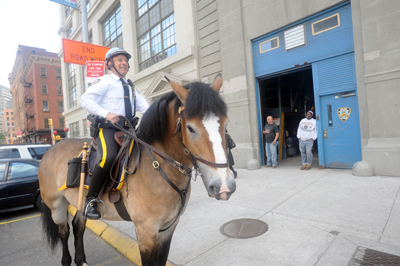
It started with a hand drawn illustration of a horse posted in my building's elevator with a poignant message from its creator, who I would guess is eight years old. My young neighbor wrote to inform us that even though she had hoped that the police department might be looking for an alternate site for the World Trade Center security command center, that hope was ill founded. The police don't have an alternative site for the command center, and here it is, three months from the 10-year anniversary of the terrorist attacks that took down not just the trade center, but the command center itself at 7 WTC.
So our beloved horses, and gentle mounted police, numbering in the single to double digits, with the open doors allowing us to see in to the stables where the dark chestnut animals eat and sleep, will be replaced with a command center manned with hundreds of police on the alert for terrorist attacks.
Photo by Carol Glassman / Tribeca Trib
The other messsage our neighbor wrote was that the fire department -- ladder 8-- aka the Ghostbusters firehouse-- was on a list of fire houses that were considered low use, thus dispensable in this round of budget cuts.
Photo by Carl Glassman/ Tribeca Trib
Given the concerned neighbor's age, it is clear that both of these community cornerstones are favorites of children under 10 who are always welcome, and often invited in to either feed the horses (when my daughter was small, we used to bring carrots to the stables) or to have a seat in the firetruck if time allowed and some life saving event wasn't going on.
When I was recently hit by a car a few blocks from these places, it took only minutes for the fire department to respond, and I am very grateful for their gentle care throughout my transfer to the emergency room at the Downtown Hospital.
This reminds me of another loss to the neighborhood, even though it is farther uptown: St. Vincent's Hospital. Their critical care unit was excellent (almost said "is" because I can't adjust to life without that hospital to call on).
The crowning blow came in the New York Post headline: Chez Perv.
Dominique Strauss-Kahn, the IMF chief accused of rape by a hotel maid, and arrested on the runway as he was making his escape, has moved into a Franklin St. address. We may not have room for police on horseback, or firemen, but bring us your rich unsavory people under house arrest
We need to hold on to the feeling of community these important institutions bring to us.
So our beloved horses, and gentle mounted police, numbering in the single to double digits, with the open doors allowing us to see in to the stables where the dark chestnut animals eat and sleep, will be replaced with a command center manned with hundreds of police on the alert for terrorist attacks.
Photo by Carol Glassman / Tribeca Trib
The other messsage our neighbor wrote was that the fire department -- ladder 8-- aka the Ghostbusters firehouse-- was on a list of fire houses that were considered low use, thus dispensable in this round of budget cuts.
Photo by Carl Glassman/ Tribeca Trib
Given the concerned neighbor's age, it is clear that both of these community cornerstones are favorites of children under 10 who are always welcome, and often invited in to either feed the horses (when my daughter was small, we used to bring carrots to the stables) or to have a seat in the firetruck if time allowed and some life saving event wasn't going on.
When I was recently hit by a car a few blocks from these places, it took only minutes for the fire department to respond, and I am very grateful for their gentle care throughout my transfer to the emergency room at the Downtown Hospital.
This reminds me of another loss to the neighborhood, even though it is farther uptown: St. Vincent's Hospital. Their critical care unit was excellent (almost said "is" because I can't adjust to life without that hospital to call on).
The crowning blow came in the New York Post headline: Chez Perv.
Dominique Strauss-Kahn, the IMF chief accused of rape by a hotel maid, and arrested on the runway as he was making his escape, has moved into a Franklin St. address. We may not have room for police on horseback, or firemen, but bring us your rich unsavory people under house arrest We need to hold on to the feeling of community these important institutions bring to us.
Sunday, May 29, 2011
Bridesmaids
When a woman gets married, it can force a wedge between her and her friends. She must sacrifice relationships that are not based on sacred rituals. She has now pledged her troth to her husband and children, and his parents claim higher priority than her best friend or even her sister. It changes the whole social matrix of a woman's life.
Bridesmaids acknowledges this painful and poignant change. Mostly it is just a very funny series of sketches about the perfect wedding run amok, which has become a genre of comedy since the wedding business has loomed large enough to become a huge industry. (One of my favorite lines comes from the bride's father who says "I am not paying for this.")
Kristen Wiig plays Annie, the maid of honor to her best friend, Lily, (Maya Rudolph), who is now moving in higher class circles than Annie is used to. A new best friend has emerged from this pricier circle, Helen (Rose Byrne) who is prettier, richer, and more ready to spend the manic energy needed for a perfect wedding.
The cast is very talented, and the love interest of Kristen Wiig, Chris O'Dowl, is so perfect she can't see it at first. There are some funny scenes having to do with police cruisers and missing persons.
It is a relief to find a comedy that is full of talented women and written by women. The few times the comedy doesn't work that well I suspect were inserted by guys and sort of just gross you out.
Sunday, May 22, 2011
MIdnight in Paris
Woody Allen's new movie gives the audience not only very attractive actors doing their work perfectly but also some philosophy to think about. How many of us have wished we lived in a different time, or thought that we were born too late? (We rarely think we were born too early.) Owen Wilson plays a successful screenwriter whose visit to Paris with his fiance brings on a bit of magic, allowing him to visit his favorite artistic era just as he is in the throes of writing his first novel. While we are chewing over the meditative bits about needing to accept the time you live in, there is some fine music being played by Sidney Bechet, beautiful costumes worn by the lovely Marion Cotillard, and shots of the city's landmarks and rooftops.
Adrien Brody does a wonderful comic turn as Salvador Dali, Kathy Bates plays a humane Gertrude Stein. All of the casting and makeup are marvelous. It reminded me a little of my other favorite Allen movies, like Zelig, and Purple Rose of Cairo where the leap off the screen, the leap of imagination is gracefully done from scene to scene, and the audience has no trouble accepting this alternate reality.
The absurdity of life pops up and makes you laugh at regular intervals, but a movie that is both intellectually accessible and challenging is extremely rare.
Saturday, April 23, 2011
Hazel Dickens
Hazel Dickens died yesterday. Her obituary was in the New York Times today. I always notice the women who rate an obit because there are not as many as for men. Dickens sang about the hard lives of the coal miners. Her voice was more mournful than Loretta Lynn, her songs had a harder edge than Dolly Parton. She sang in the movies Harlan County and Matewan. You can hear her sing here: Fire in the Hole. Her voice goes right through me.
Sunday, April 17, 2011
Source Code
Science fiction about time travel trips me up. It depends on the belief that someone can be in two places at the same time. Source Code would have us believe that the main character played by Jake Gyllenhaal is not traveling through time, he is just living in an alternate reality in order to discover the criminal intending to wreak havoc on a major metropolis. He can go back to the last eight minutes of an explosion when everyone on a train is about to be killed, an infinite number of times. Each time our hero learns a little more about a crime about to take place, and Gyllenhaal's delivery of the lines he must repeat over and over again is one of the pleasures of this film. He is the not the only one whose acting buoys up a rather baffling premise. There is lovely Vera Fermiga as a sympathetic military official, and Jeffrey Wright chewing the scenery as an evil scientist, and Michelle Monaghan looking winsome as the love interest.
Even though it left me scratching my head, I enjoyed the movie's well edited suspense.
Monday, April 4, 2011
my mother's eye is scratched
This morning my eye feels itchy, as if there is a very fine hair that if I could just remove, all would be perfect. The little orb would go back to lying in its perfect solution of fluid. But this is an illusion. No matter how much I scratch at or poke at or try to tug the sleepers from the corner of my eye, it still feels as if something infinitesimally small is trying to work itself free and not succeeding.
Earlier this week my mother suffered a scratch on her eye. She is being treated for macular degeneration with laser therapy to reduce the errant blood vessels that are blocking her macula, that centerpiece of the eye that keeps things in focus. When she went home, she was in pain, and the pain increased, and her eye was swollen. She phoned the doctor who had her come back to his office, and learned that her eye had been scratched. "This sometimes happens" was the doctor's explanation. (Wouldn't you like to throttle him?)
Am I feeling sympathy pains, or worrying that I will soon suffer the same eye disorder as my mother since it is genetic. Or maybe is it just a case of itchy eyes.
Friday, April 1, 2011
Le Quattro Volte
You don't need to know how to speak Italian to watch this Italian movie, and it has no subtitles. The movie is not purely visual though the photography is quite wonderful. It has an important soundtrack which consists of the sounds of men tamping down charcoal beds with shovels, goats bleating before being milked, a woman sweeping the floor in a church, a sheep dog barking, the final block being put into place in a mausoleum to enclose a casket. The action moves from a forest where a goatherd tends to his flock, then to the man's house where he tends to a nasty cough with a potion poured out in a folded up magazine page.
The potion is very important to the man whose cough does not improve. A town performs a passion play complete with a christ figure carrying the cross up a hill to join two other crosses already in place.
The camera is never too close to people, with the exception of the goatherd. Most of the shots are long shots. The goats are shot close up and we get to know them pretty well. The mountains, the trees, the dog, and especially one very tall pine tree, these are our familiars by the end of the picture. The picture begins and ends with smoke. We learn how charcoal is made in an ancient practice with an architectural form worthy of Stonehenge.
I remember in the preview the title was explained-- something about how man lives "four times" -- as mineral, vegetable, animal, and thinking being. We watch the coal, the pine tree, the baby goat, and the old shepherd progress from beginning to inevitable end, as smoke.
Thursday, March 31, 2011
Heard a Mockingbird today
Heard a mockingbird today singing its heart out in the middle of a bush as we walked east on 23rd St in the middle of the day. At first we thought it was an alarm, the sound was so exaggerated and loud. Then I located the animal, his head thrown back like Edith Piaf, going through its extensive repertory of imitations, including a catbird, a starling, a robin, a catcall, an engine warming up, a towhee, a whistler, and on and on it went. Another man paused to listen. He didn't need to look, just to listen as the concert continued for five minutes. No amplifier needed, this thing was singing for the upper deck. The bird's white-streaked tail was tipped way up to the moon as it gave its heady aria to all passersby for free. It was full of joy.
Morgan Library: Diaries
R and I went to the Morgan to see the Diaries exhibit. Thought of the difference between diary and journal. Both keep records, but diary implies daily, more everyday events, keeping track of what you did, who you saw, what happened. Journals keep for writers records of what they mean to do, experiments, drafts of things, even.
Examining three centuries of diaries made us want to begin keeping a diary right away. You could tell how successful the exhibit was by the expressions on the faces of the visitors. Many were smiling that blissed out smile of surprise that comes with unexpected pleasure.
Some highlights:
--an oversize notebook of John Steinbeck kept while writing the Grapes of Wrath.
His goal was to write two pages a day, so simple.
--diaries of Thoreau whose beautiful penmanship wrote each carefully chosen word
-- E/B White's typescript of writing about his childhood every day which led to the opening of Trumpet of the Swan.
--Walt Whitman's tender record of the wounded soldiers in the Civil War
--Samuel Pepys' writing in shorthand about the London Fire
--Charlotte Bronte's griping about her job as a teacher in a boarding house
--American record of the Boston tea party
--Hawthorne family diaries
Whether writing down history, or recording what your family had for dinner, diaries bring to life what has passed.
Barney's Version
Barney’s Version
Paul Giamatti is having a great career. He has played John Adams, Harvey Pekar, and Joe Gould as well as the misanthropic wine taster in Sideways. In Barney's Version, he plays a man whose life we see develop from youth to the
onset of senility. Sometimes because of certain plot elements, we
wonder if the version Barney gives has something to do with a crime, but it turns
out that we see things through his eyes as he falls in love and stays in
love with the lovely woman he finds at his second wedding.
He really loves this woman, and she is worthy of his love, but is he worthy of hers? We are not quite sure with all the scotch drinking and cigar smoking if that is enough to understand his character. It isn’t Giamatti's fault. The men who create Barney's foursome of friends have more life together than the man and the woman at the heart of the story. The direction lingers too much on the scotch drinking and seems repetitive or draggy in ways that keep the characters from truly developing. Giamatti is a fine actor. Dustin Hoffman plays his father beautifully. (Hoffman’s son plays his grandson and is also quite good). Barney’s second wife, played by Minnie Driver, is delightful as a vulgarian with her master’s degree being waved in his face every other minute.
There are fine details and charming scenes mostly between the men which create a feeling of poignancy, of a life really being lived. For this I am grateful. A movie about a realistic person who chased a woman for years until he could marry her and never fell out of love with her, that is a sweet dream many of us could wish for. So I forgive the movie its flaws for its romanticism.
Saturday, March 26, 2011
My Favorite Website: NYPL
Where else can you find important answers to reference questions and an image of the day and put all sorts of poetry books on hold for later pick up but the New York Public Library?
The image at left is of the McCoy Sisters, I know not more than that, but I find their movement and expression delightful since I take such delight in my sisters.
New York Public Library
Thursday, March 24, 2011
Cedar Rapids
We watched the movie, Cedar Rapids, at a 1 o'clock show in a theater where we were the only two there. I guess the movie is at the end of its run. How delicious to see a movie on a Thursday afternoon when everyone else is at work. Another man sat in the back, who turned out to be one of the staff. When the lights went down, he announced that the show would now begin, and we should enjoy ourselves, and then he left. This is not usually how movies start at big chain theatres.
The main character, named Tim Lippe (Ed Helms), is a rube, simple, naive, a boy in man's clothing. He has never left his home town of Brown Falls, Wisconsin, so when he is called on by the head of his insurance office to attend a convention in Cedar Rapids, which is a big town for this guy, he is so green he deosn't know that everyone, even him, has to go through security check, even when the security check guy is someone he knows very well.
Once in Cedar Rapids, the blowhard, played by John C. Reilly, the hip woman, played by Anne Heche, and the stolid roomate, played by Isaiah Whitlock, give our hero a little seasoning. Alia Shawcat, who played Maebe on Arrested Development, does a fine turn as a hooker. All the women, including Sigourney Weaver who bravely allows the camera to show her age, hold their own in this male id-centered comedy. The comedy comes and goes, but at heart, the film is a coming of age story for the sweet insurance salesman. It gives honest businessmen everywhere a reason to cheer.
Sunday, March 20, 2011
Bill Cunningham New York (movie)
Sunday, November 28, 2010
Inside Job
This muckraking movie makes me mad with its shocking analysis.
People are interviewed from Iceland, where banks once regulated and stable were deregulated and drowned in debt, nearly bringing down the government, and laying off thousands of people. In a country of 300,000 that has a huge impact. In the United States where deregulation began with the Reagan administration, the continued ripple effect on the global economy resulted in larger layoffs, more recessions, and continues to this day under Obama and what one interview subject called the "Wall Street government."
Money is made on debt that cannot be paid. The higher the debt, the more leveraged the bank becomes, until eventually, so large (too large to fail), the executive who was supposed to be overseeing this, bails out and gets his package, which includes millions of dollars. Sometimes these executives, knowing that the company is headed south, sell their shares and take them home with their severance package, and here's the funny thing, their heads held high.
When what you are selling is so complicated that it cannot be explained without a programmable calculator something is wrong. And it is sinking the financial markets around the world. Unbridled capitalism bankrupts us all, punishes the poor, and makes the rich make out like bandits. This movie urges us to take the system back from the criminals. And to change the way government works. This movie, though most of its heavy firepower is aimed at the GOP, does not exempt Clinton, sitting very cosily with the biggest of the marauders, or Obama, who has allowed the status quo to continue.
There are some heroes in this film, who speak before and after those caught red handed. Unlike the Federal Reserve Governor, and the Harvard University economist, and the bankers forced to testify to Congress, there are heroes like a consumer advocate who warned Greenspan, and then Bernanke about what was happening to no avail. There is an executive at the International Monetary Fund whose paper was published criticizing the mathematical model that used derivatives to make money on bad mortgages; he was subsequently shunned. George Soros says some things about the inequity of executive compensation that sound dead on.
Eliot Spitzer sits in a large vacant room with miles of windows making us wish he had never gotten in trouble with someone not unlike the madam who was interviewed earlier about what Wall STreet traders like to do after their fifteen hour days on the floor. Spitzer reminds us how he used to go after the people who were raiding consumers' accounts to line their own pockets. He says he isn't in a moral position to say much about their morals now. Damn.
Tuesday, November 9, 2010
Howl
Howl with James Franco
The movie begins with a recitation of the poem as it might
have been delivered in a dark subterranean coffee shop in San Francisco in
1955, shortly after it was written.
James Franco wears the thick black horn rimmed glasses, the white t
shirt under the buttoned down white shirt, just the way that Ginsberg wore these things.
Franco’s voice takes on that raspy incantatory drone that was Ginsberg’s performance
persona. The voice, and the juicy
words that run on and on return us to 1955 – but do these lines speak to us
now as they did in 1955? Perhaps we do not need them now as we did then.
![]() |
| James Franco |
The opening titles show glimpses of the animation to come. Armies of men carry identical brief cases, wear identical hats, march across an unknown grey city. Photographs of Ginsberg and Orlovsky, his lifelong partner, actual photographs, look a bit scruffier than the cleaned up actors who play their counterparts. The cold war is represented by missiles pointing ominously toward us the viewers. In this context, the beat poets were railing against conformity, against war, against restrictions of all kinds.
Franco plays Ginsberg especially well when he is full of
longing. He speaks to an unseen
interviewer (the script comes almost entirely from transcripts, interviews, and
the poetry itself) about his journey from a young poet wannabe in the shadow of
his straight traditional poet father.
His sexuality he hid from his parents. He was put in an insane asylum when he was 21 ostensibly
because of his homosexuality, and was released when he agreed to become
straight. After two years of
working in advertising and rejecting his true nature, his therapist encouraged
him to do what he wanted, and the rest is history.
![]() |
| Allen Ginsberg |
The animations in the movie are distracting. The images of star bursts that denote orgasms, the explicit sexual couplings, detract from the power of the words. But this is a movie. I can see why the filmmakers thought so much time with just the words-- staring at the screen, listening to Franco recite, might be boring without some action.
How gratifying to hear a poet's words treated with the seriousness of a love affair, or a war, or a heist, or some other common subjects of movies. I remember when the movie came out about Sylvia Plath. They had everything in that movie except the poetry. This movie has the poetry front and center and I am grateful.
Thursday, November 4, 2010
Poets Forum on Contemporary Poetry:Wild and Strange Language
![]() | |
| Lyn Hejinian |
Carl Phillips Ron Padgett |
![]() | |
| Kay Ryan |
Hejinian read examples of what she thought of as showing wild and strange language. (No poet would like to be accused of using tame and ordinary language, she said.)
First came Robert Grenier, from his book "Sentences", available online.
She may or may not have read this:
PAW
he barks at things gone by
two trees
stepping through the water to the rocks
five sound shut doors
LOOKING AT FIRE
ashes to ashes
looking at the fire
at has been added
ashes to ashes
looking at the fire
at has been added
Hejinian champions the use of language in an aesthetic sense.
Padgett ruminated on his childhood a bit, thought of how language is enjoyed sometimes without meaning necessarily. Children like to repeat sounds over and over again until they are drained of meaning and remembered as something else, something coming in to the ear. He also enjoyed discovering the concrete poets, the wild poets whose works contain pure sounds and playful shapes on the page. Later, he pointed out that William Carlos Williams' poems in Spring and All were electrifying. The red wheelbarrow poem said it so plainly. Padgett is charming and funny, and full of plain spoken truths, with a childlike simplicity that is seductive.
Phillips handed out a leaflet with two poems : on one side from Laura Jensen, "Heavy Snowfall in a Year Gone Past," which ends with the moon looking down and judging,
not the maze of anger
but the fury
at the wasted years,
at the waste of the tender snow
Wasted, wasted, the birds crackle,
wasted on you.
Wasted, wasted, the birds crackle,
wasted on you.
There was also a deeply erotic beautifully structured poem by John Wieners, "Anniversary".
The diction changes mid line
Cigarette between his lips, would they were mine
by this present moon swear allegiance
if he ever look, see clouds and beaches
in the sky, by stars lend his eyes shine.
Kay Ryan had brought this poem by Robert Frost. She asked if we received the handout. When there was an awkward silence, she replied, "I didn't bring one."
A Dust of Snow
The way a crow
Shook down on me
The dust of snow
From a hemlock tree
Has given my heart
A change of mood
And saved some part
Of a day I had rued.
What excited Ryan was how poetry could change a person. The person in the snow was not in a good place, and as a result of the snow falling on him, had entered a new mood. Such simplicity, and tight little form has the power to create a feeling.
Hejinian challenged that poetry did not have to do that, that was too restrictive.
"Restrictive!" cried Ryan.
And so Poet A and Poet Z laid out their positions. It was an argument we could have used more of. But it was enough for me to understand the difference between Hejinian's point of view about poetry, that it should have as much breadth and range and abstraction and freedom as jazz or a Jackson Pollock painting, and Kay Ryan who wants her poems to have words with meaning. With no meaning, you have no power, she claims, and I agree.
Sunday, October 3, 2010
Thursday, September 30, 2010
Weather
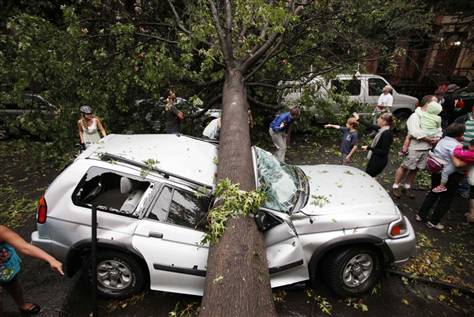
Scary weather lately. A tree fell on a car and killed a woman waiting patiently inside for the winds and water to pass. Trees are now becoming something to be leery of. Some of them have fallen on pedestrians in Central Park. Trees used to be the thing we rested under, sought for shade, looked at in wonder when their leaves changed color. Did New York used to have tornadoes?
Monday, September 6, 2010
Matisse: Radical Invention, 1913–1917
![]() | |||||||||||||||||||
| Henri Matisse painting Bathers by a River, May 13, 1913. Photograph by Alvin Langdon Coburn. Courtesy of George Eastman House, International Museum of Photography and Film, Rochester |
The first gallery of paintings showed how Matisse was taught to paint copies of the masters, but learned to develop his own interpretation of the classic compositions, beginning with a series of paintings on the subject of Arcadia. What a great subject for a series of poems.
I was captivated by this drypoint of Greta Prozor.
![]() |
| Drypoint, Greta Prozor, MOMA |
Friday, September 3, 2010
Women Outside: conversations about nature, art & spirit
In Women Outside: conversations about nature, art & spirit, Mary Olmsted Greene has conducted conversations with thirteen women whose lives are enriched by the spiritual qualities of nature. It is an eclectic group of women with a great variety of things to say about how nature has formed their consciousness.
One woman rescues wild animals.
Another raises sheep and lives completely outside of the grid.
One woman teaches dance.
Another is a shaman whose training is based on African rituals.
One is an Episcopal priest whose dog is part wolf.
There is a girl who is nine years old.
They all respond to the same batch of questions about their lives, how they were formed by the wild or wilderness, what their thoughts about evil are, and Greene intersperses her interviews with poems that complement the conversations in verse.
The book opens with Greene's own reminiscences of growing up near the ocean, her move to New York, her youth spent bicycling the streets of Manhattan, her wild days, her glory days, spirited and free. This opening essay is one of the best things in the book. She discusses "nature deficit disorder," a modern psychological problem for those of us deprived of the natural world. From New York City, Greene moved to Sullivan County in upstate New York with her young child and many of the women interviewed in the book come from that region.
Here is Eileen Pagan's response to the question, "what does wilderness mean to you?"
Dorothy Hartz's responds to the question, "What in your life has brought you close to wilderness, or wildness?
The book makes me want to live in the wild before there is none left.
I found a website recently by the great environmental artist, Maya Lin. It is called
What Is Missing?
Lin is a woman who has found a way to give tribute to the beasts and beauty of nature in her haunting audio-visual art.
Greene's book and her poems about nature give voice to what we long for that is not human, but essential to our humanness.
One woman rescues wild animals.
Another raises sheep and lives completely outside of the grid.
One woman teaches dance.
Another is a shaman whose training is based on African rituals.
One is an Episcopal priest whose dog is part wolf.
There is a girl who is nine years old.
They all respond to the same batch of questions about their lives, how they were formed by the wild or wilderness, what their thoughts about evil are, and Greene intersperses her interviews with poems that complement the conversations in verse.
The book opens with Greene's own reminiscences of growing up near the ocean, her move to New York, her youth spent bicycling the streets of Manhattan, her wild days, her glory days, spirited and free. This opening essay is one of the best things in the book. She discusses "nature deficit disorder," a modern psychological problem for those of us deprived of the natural world. From New York City, Greene moved to Sullivan County in upstate New York with her young child and many of the women interviewed in the book come from that region.
Here is Eileen Pagan's response to the question, "what does wilderness mean to you?"
One of the qualities that defines wilderness for me is that sense of quietness, being with water, trees, rocks and sky, and knowing that there are living creatures of all the various sorts that are out there. The foxes, for instance, which I rarely see. I do see the little chipmunks, snakes, and raccoons, and groundhogs, and all the millions of little creatures in the water in the summertime. Those beautiful flying neon--what are they called? Darning needles? Down by the waterfall they are magnificent.
Dorothy Hartz's responds to the question, "What in your life has brought you close to wilderness, or wildness?
I don't think you necessarily have to be in a natural setting to experience wilderness. It helps a lot, and no doubt most of what we call wilderness encounters do take place in a natural setting, but...To me, wilderness is a state of harmony based on an absence of ego-consciousness. It belongs to the organic world, to the world of instinct, whether in or out of doors. We are in the wild whenever we are at peace with that. We're innocent.
![]() | |
| Mary Olmsted Greene |
I found a website recently by the great environmental artist, Maya Lin. It is called
What Is Missing?
Lin is a woman who has found a way to give tribute to the beasts and beauty of nature in her haunting audio-visual art.
Greene's book and her poems about nature give voice to what we long for that is not human, but essential to our humanness.
Saturday, August 21, 2010
The Kids Are All Right
During the summer when I live in the country with access to only a few multiplexes, I tend to read more about film than actually see any movies. When hype accompanies a movie during my desire for any non-Hollywood productions, I become a little too greedy for something better than average. The Kids Are All Right sounded like it would satisfy my appetite for that.I have a huge crush on Mark Ruffalo. He does not disappoint. His charm comes from that gruff voice of his, and his natural, chilled out, thoughtful way of behaving.
The children in the movie are superb especially some very strong scenes with the boy named Laser played by Josh Hutcherson and Ruffalo. The writing of these scenes is just right. Cholodenko, the director, and her screenwriter partner have created a mostly believable script.
I found the character played by Annette Bening to be unlikeable from the get go. She is either strident, drunk, or weeping. It would be nice if we knew what the lesbian couple actually saw in each other. They don't really work in a believable way. They are constructs. Julianne Moore needs to be in more Paul Thomas Anderson movies. She has been cast badly lately and I wonder if it has to do with her age. Same goes for Bening.
I did find myself laughing occasionally. The movie is not hard to watch. But it has been overpraised probably because there is so little quality to be had during the summer.
![]() |
| Mark Ruffalo |
Sunday, August 15, 2010
Inside the
Confessional
Saturday afternoons we went to Confession.
That gave us all day to play.
The dirt got to be soft with kids going back
and forth, a perfect spot for playing marbles.
With a stick we drew a circle in the dirt
and in the middle of the circle was a hole.
We aimed at the hole to win.
We fought over cats eyes and keepsies.
Sure, there was cheating in that small place,
leaning down in the dirt. We got really
sweaty in the summer playing there.
After, our mothers turned on the sprinklers
and we rinsed off so we wouldn’t have to take a bath.
Inside the church, by the darkened booth,
a line would
form for the nice priest
who gave easy penances: three Hail Marys,
that was it, we were off scot free,
safe from the licking flames of hell.
Monsignor McDowell never had a line.
He said our tongues would turn to worms
if we kept up our
lying to our little brother
about where we kept our candy.
We held our breath and lied about our sins.
Once inside, we were invisible,
hidden from the world, just us
and the plaited rush partition that let
our sins into the priest and his forgiveness
fly out to us on the other side.
We listened for the sound of the shift
of the slot. Then
we would begin
to list our wickedness. The penance lifted
the grit and washed the tiny flecks of mud.
All clean, we
were free to go out and sin again.
Sunday, August 8, 2010
Black Swallowtail Butterfly on Queen Anne's Lace
I was about to throw out some old flowers I had picked on the side of the road when I noticed a caterpillar on one of the old Queen Anne's lace. It turns out that Black Swallowtail butterflies like to eat the parsley family which includes that flower. So I am hanging on to the cluster of broken down flowers, and am going to see what develops.
They eventually look like this.
You can see from the first picture that caterpillars are not the only insects in our house.
Thursday, August 5, 2010
Millipedes
Millipedes are common here. Some of them have wandered into our house, and had to be evicted. I find them fascinating and more appealing than centipedes.
They have reddish stripes to mark off every ten feet (as in pedes, not 12 inches). Their shell looks hard as armor, and tough to break.
| Centipede |
Centipedes are hairy wider creatures that are soft in comparison. They actually look a lot creepier, and have only around 30 or 34 feet compared to the millipede's nearly 80 by my count. Also centipedes can bite. Millipedes just give off an ugly smell as self defense, or they roll into a ball so that you can't pick them up or hurt them.
Wednesday, August 4, 2010
Salt/dir. Philip Noyce
Angelina Jolie works really hard in this movie. She makes me glad that my job description does not include getting tortured in my underwear, or assassinating the president of a superpower. For Angelina, it's all in a day's work. So what if she is called on to invent a small howitzer out of a vacuum cleaner and some chemicals in the office? She is very well trained. She also manages to jump from the overpass of a highway onto semi-truck, then switch to another truck, then an oil rig, until finally she infiltrates a cab which slams into a police car, using each of these vehicles like catapults to get to her destination. Ultimately her destination is St. Bart's Church in Manhattan where a VIP funeral is taking place. The Russian president attends, so is available to be assassinated.
The assassination involves trap doors, spider venom, and more chases and spills and car crashes and our Angie, she walks away without so much as whiplash. She is a human torpedo. Wait, there is a moment when she has to dress a wound, and finds a kotex machine which she rips off the wall in order to get at one of those paper wrapped cotton products.
Also in this movie, and holding his own with such a superhero presence is Liev Schreiber.
![]() | |
| Jolie as Salt |
![]() |
| Liev Schreiber |
Leave it to Chance: a Tribute to Merce Cunningham
It’s not something too common, dancers over forty, over
fifty even. At the Leave
It To Chance concert at the Beaver Brook Cottage, Karen MacIntyre and Loretta
Thomas began the program with a tribute to Merce Cunningham who recently died
at age 90, and continued to perform past his middle years. But these women were not performing
Cunningham’s choreography. They had created six dances with the music
of David Anderson to express how they felt about “the Einstein of dance.”
![]() |
| Karen McIntyre |
| Loretta Thomas |
Mary Greene read words by Cunningham that described his philosophy of movement. Thomas and McIntyre, two seasoned dancers, knew how to move to this monologue and convey to the audience
what the movements meant. I was moved
by the beauty of the balance of the two women, how carefully they intersected
each others’ spaces, especially in the first dance entitled “Radical and
Formal.”
In "Trio," a third dancer, Leah Giles, who had been trained by MacIntyre since a very young age, joined the two older women and we were able to see the contrast between the very young and the middle to older bodies.
The small space at Beaver Brook allowed me to sit so close I felt open to a very sensory experience, not only seeing the detail of every body on stage, but also noticing textures, sounds, smells. A large avocado plant in the background framed stage right and an altar with threeunlit candles gave an aura of a sanctuary. Three elegant light fixtures hanging from the high ceiling cast a curved shadow.
Merce said, "First you have to begin with the
most difficult thing, getting up." These words were repeated several times in "In the Mean Time..." in which the Gaia company of dancers, young and old, joined the two principals. What a feast for the eyes, to see so many body types and faces all crowded into the large living room, dancing to David Anderson's excellent music which aptly matched the movements. Even though Cunningham made an eloquent case for his dances not needing music (there is so much to notice in the movement, the music is a distraction), I have to admit I much prefer it. There is something so satisfying about watching a well trained, well rehearsed body move to the rhythm of great music.
After the intermission, the Gaia Dance Collective performed, each dance choreographed by one of their dancers. The program closed with a very winning "Swing Guitars," full of humor, whimsy and fun.
Karen McIntyre explained somewhat wistfully that this would be the last performance of her Triad company in Sullivan County. It is difficult for her to come to New York from Texas where she lives and teaches. But she left us with a humorous series of monologues in the voices of the residents who first greeted her when she was just establishing her dance studio.
Sunday, August 1, 2010
Inception
When did Leonardo DiCaprio grow a vertical line in his brow? In Inception, he plays Cobb, an expert at prompting other people's dreams to be available to him so that he might steal what secrets lie therein. Cobb has a lot to worry about since his wife in the dream state keeps trying to murder him or get
back at him or get him back. His new mission is to go into a man's dreams and plant an idea there, an idea that will benefit a corporate client mightily. It will be necessary to outwit or outshoot the security police who guard the dreamer's dreams. There is also the risk of landing in limbo if after the third level of dreaming you get stuck between levels one and two.
Besides learning how the invasion and creation and manipulation and suspension of dreams work, the viewer is treated to hair raising action scenes, one piled on top of the other. It is hard to keep from admiring the visual mastery of the dream sequences mixed in with these action scenes.
Joseph Gordon Levitt plays the part of Arthur, one of the team of experts who help Cobb on his missions. He is supposed to lack imagination but he walks on the ceiling with ease. I can't wait to see Gordon Levitt's next movie, not that he outshines anyone else in a cast that includes Tom Hardy as the shape shifter, Michael Caine as a concerned father, Ellen Page as a wizardly architect and Cillian Murphy as a very well protected victim.
Next day, remembering the scenes of the architecture breaking up and going sideways, and of the mazes the dream architect invented, and of the van falling off the bridge for what seemed like days, I hoped that my dreams would become a bit richer in visual content. But poor Leonardo. He has lost his boyish look. The groove in his forehead is there to stay.
Friday, July 30, 2010
Lake Shore Limited by Sue Miller
I got sucked into it willingly, this familiar Sue Miller terrain with its combination of realism, manipulation, and current events. Once I was at page 100, I thought, why am I reading this soapy stuff, and then dashed through without coming up for air until I was done.
The thing about Sue Miller is that I sort of expect the worst for her characters. She has the ability to create a feeling of suspense, as if something important is going to happen, just give it another five pages, and then the action I was expecting fails to occur. I feel like a ninth grader unsatisfied with her ice cream choice. Then why do I keep going?
I keep going because I am her audience. I am a middle aged, middle class, educated woman. That is who Sue Miller writes for. Her characters come from that class. They are professors, doctors, architects, realtors. They are in helping professions. Some of them are teachers. I recognize these people. They are mostly married, and have sex in graphic detail. One of the keys to happiness is orgasm. You can tell how happy by how many orgasms the character has.
So there is this tie to the physical life of the characters in her narratives. Lake Shore Limited is about a playwright whose live-in lover was killed in one of the planes on September 11. Her new play touches on an act of terrorism that may have killed the wife of the main character while he is engaged in an affair and trying to break free of his wife. When she is missing from the train that was blown up, he is at the brink of deciding whether to stay and play the dutiful bereaved widower or leave and begin his life with his new woman.
The book centers on the play and I thought why not just include the play in its entirety in the book, but the point of the book is to have each of the four main characters grasp the meaning of the play as it relates to their lives.
The structure of the book switches from each of the four characters at regular intervals. At one point, one of the characters says about another: "Not the brightest bulb in the chandelier." Exactly. Sometimes the characters seem awfully slow to catch on what is obvious to the reader.
Still, I have been mulling over this book, thinking about the dilemma of what your duty is to the dead who are killed in acts of terrorism. It is a strange obligation that comes with the mourning of people instantly snatched up by the media and patriotism and other things unrelated to who the person was or what your relationship was with that person. This is at heart a very thoughtful treatment of a new kind of subject.
Thursday, July 29, 2010
Wild Turkey
Yesterday while taking a walk down the driveway, I noticed something moving in the grass to my left and bent over to see what it was. A female turkey burst up at me. A blur of feathers and beak and talons grew to my size, menaced me with her loud angry voice. Her wings and feet rattled, meant me harm. My heart pounded in my chest. I was stunned and stood still, then realized that this was not what the turkey wanted. She wanted me to go as far from her and whatever she was guarding as quickly as possible.
I ran to the road and didn't look back.
Tuesday, July 27, 2010
Cheri
Colette's perfect novel adapted in this imperfect film demonstrates the difference between movies and the books they come from. On the one hand, cigarette smoke wafting over someone's head in a long shot with the foreground a lovely border garden evokes a character and another character's feelings about that character in just a few seconds. On the other hand, Colette's tone of voice in the book is full of archness and wisdom. As readers we have the time to take it in, to let its seduction take hold. The narrator's voice in the movie is a man's, and feels forced and trying to fill in the blanks and intrusive.
The moving images of the movie are beautifully apt to the Belle Epoque settings, its architecture, interiors, and gardens. The costumes are sumptuous and steal the show. The actors all do a fine job epecially the title character, Rupert Friend, as the callow youth whose beauty is his undoing. I do not agree with the casting of Michelle Pfeiffer for this part. She is so thin, and carefully preserved when what is called for is someone fleshy and just past their prime. Is it true that the camera could not record her actual face in order to give the illusion of preserved beauty in one so far past forty? She is too much a product of California, blond, lean, and hip, to play a voluptuous Parisian courtesan. Her voice is all wrong especially in the beginning when she seems to be faking a British accent (why? because Friend is British?)
Was Helen Mirren not available? Or Charlotte Rampling? Something about Pfeiffer's face says surfer to me. I know that she has the chops and all that, having played loose women etc but still, that was in American pop culture type things like Scarface and Baker Boys. This is the cream of Colette's oeuvre and she just doesn't work in the part.
Everyone else does, thank goodness. In the end I think the movie is about the mother making one hideous decision after another, and Kathy Bates plays the mother perfectly.
Oops, said Kathy Baker by mistake. They are so different!
Kathy Bates Kathy Baker
Thursday, July 22, 2010
What is it about the internet?
There have been many articles recently about the effect of
constant connection to electronic devices on our brains. Are humans
becoming less human as a result? What is it that makes us human?
Do we need to stay connected to a machine to feel part of the conversation at the cost of having a conversation with a real live person we might like to sit with at leisure over coffee?
I think there is an epidemic of loneliness. My theory:
It is an addictive habit like smoking.
It takes practice not to use it so much.
There are so many things I want to know.
The internet provides answers.
Yesterday these were the things I looked up which can give you an idea of what my life is like:
how to clean and re-season a cast iron pan (I overzealously cleaned it)
recipe for corn chowder (love to eat, love to cook with fresh summer vegetables)
national weather forecast (when will the heat move on?)
cat ear infections (poor kitty)
writers almanac (need fresh poetry, Garrison's voice)
pictures of hummingbirds (they are crazy little buggers providing endless entertainment)
cornell's website on birds (wow why so many flycatchers here?)
New York Times crosswords (another habit forming )
New York Times op eds and obituaries (okay the news comes last)
email five times (who wants to talk to me remotely, who do I owe messages to)
zen habits (where are the date stamps on these articles?)
flickr pictures of rural librarians (what would it be like to work in the country)
In the country
Waking up to the sound of birds, to the sight of a forest, to the smell of fresh air, is more than restorative, it seems necessary. I think of what it would be like if I were in the city right now, at 7:30 AM. The sound of the men setting up their construction, the subway under my feet, cars, trucks, taxis, horns honking, the smell of the heat and ozone, diesel fuel particulate accumulating on my window sill.
There are trucks laboring their way up hill in the woods to build a new development somewhere.
But in the city, I guess what we don't have here in the country, is lots and lots of people with lots and lots of needs. They need to eat so there are restaurants on every corner, a grocery store every few blocks. They need to get dressed, and live somewhere, more shops, apartment buildings reaching the sky. They need to get from place to place, so there are subways and buses and taxis and roads and traffic lights. They need to use the toilet and their sinks and their bathtubs so there are sewer lines. They need to read at night so there is electricity. They need to cool themselves so there are air conditioners and fans and the electrical grid is amazing.
Here where there are not as many people, there are birds, lots of trees to house them and give them food. The squirrels do not beg from me as they do in Central Park.
Wednesday, July 21, 2010
Funny Animation
One of the benefits of belonging to Roger Ebert's Club (a subscription you can join on his blog) is finding the extra films and clips he provides. Here is one I particularly liked, sort of seasonal to the summer.
Subscribe to:
Posts (Atom)


Carl Phillips
Ron Padgett